


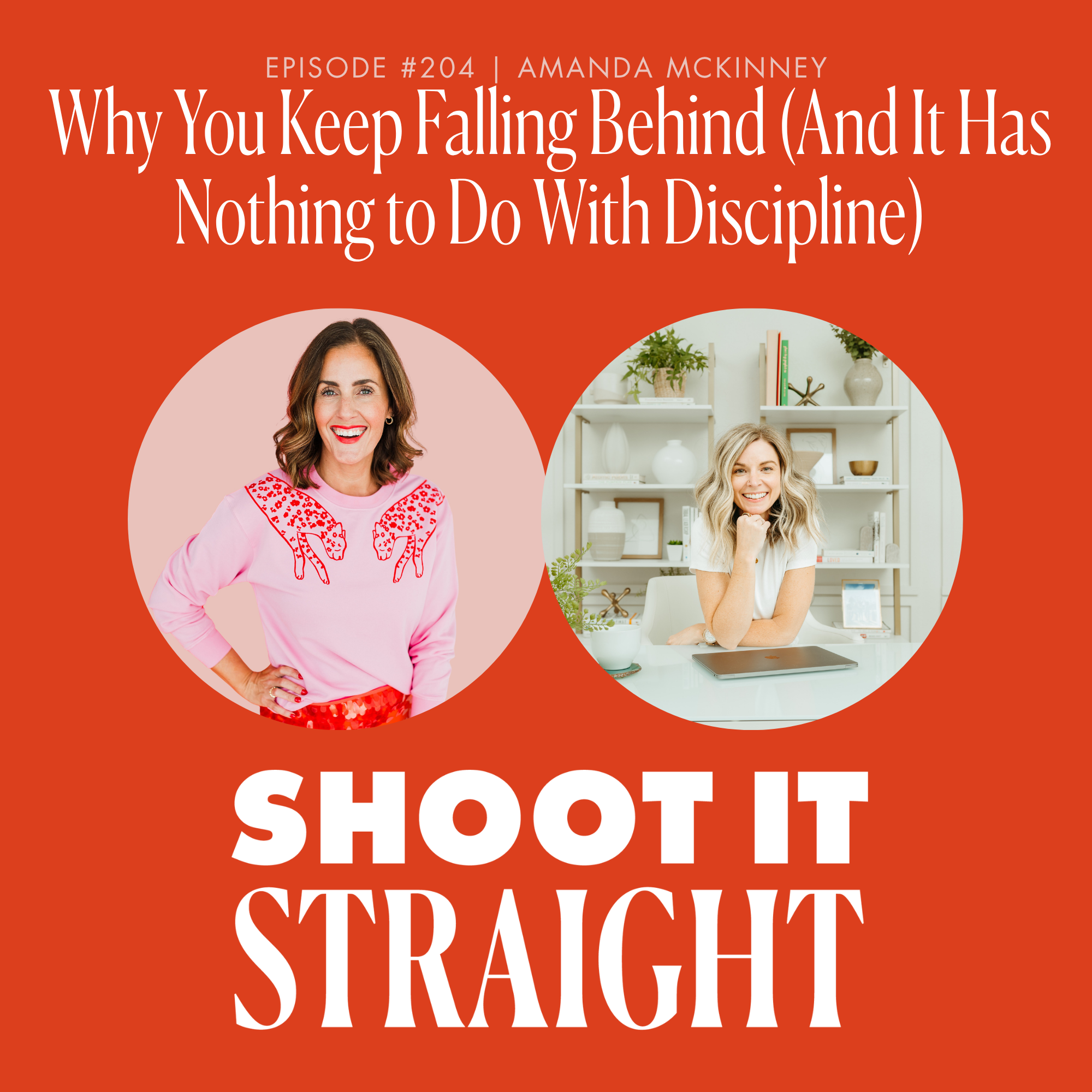


Are you constantly working, but feel like you’re still behind? In today’s episode, I’m chatting with accountability coach Amanda McKinney about the common problems entrepreneurs face with overwhelm and not having enough time. Plus, where to start to get out of that “stuck” feeling.
The Shoot It Straight Podcast is brought to you by Sabrina Gebhardt, photographer and educator. Join us each week as we discuss what it’s like to be a female creative entrepreneur while balancing entrepreneurship and motherhood. If you’re trying to find balance in this exciting place you’re in, yet willing to talk about the hard stuff too, Shoot It Straight Podcast is here to share practical and tangible takeaways to help you shoot it straight.
Make sure you’ve hit that follow or subscribe button on your favorite podcast player to get notified each week as we air new episodes!
Subscribe on Your Favorite Podcast Player
Apple Podcast App | Spotify | Amazon
Review the Transcript
On today’s episode of the Shoot It Straight podcast, I’ve got my new friend Amanda McKinney with me, and we, we’re having a really great conversation. And we are talking about this thing that all entrepreneur women that I have ever met and ever worked with struggle with from time to time, and it’s this feeling that we’re not doing enough, we’re not getting things done, we’re not moving the needle.
And there’s so much beneath that thing of, “I don’t have enough time. I don’t have enough time to get all my things done.” There’s so much there, and Amanda and I are digging into that today. I’m gonna be real honest. I had planned the conversation to go one way, and we did veer off quite a bit, but every single thing that she says is like a mic drop.
It’s so good. I know that I will have her back on the podcast because I can’t wait to dig into this more, but this is really a great episode. So if you have ever had those thoughts to yourself of, “Why can’t I seem to get everything done? Why can’t I seem to make any real progress towards my goals? Why isn’t my business moving forward or my life moving forward like I want it to?”
This episode is for you, and I can’t wait to dive in.
Welcome to Shoot It Straight, the podcast for women building businesses and lives they actually want. I’m Sabrina Gebhardt, and around here we believe in clarity over hustle, alignment over burnout, and giving yourself permission to want more: more ease, more beauty, more income, more space to live. So if you’re ready to grow without losing yourself in the process, you’re in the right place.
Welcome back to the Shoot It Straight podcast, my friends. Today I have a new-ish friend joining me. She’s new on the podcast. I met Amanda at the Creative Educator Conference, uh, this past spring, and immediately was like, “Well, I’m obsessed with you, and we need to connect in all of the ways possible.” I knew I had to have her on the podcast, and I have binged her podcast.
Again, I became obsessed with her when we were chatting in person, so I just know that today’s episode is gonna be so, so good and I cannot wait to get started. But before we get too far in, Amanda, why don’t you introduce yourself to the audience? Will do. Sabrina, thank you so much for having me. I also became obsessed with you immediately and went down the rabbit trail of like, I have to consume all the content, so I’m loving this podcast so freaking much, and just how authentic you are, not only on the podcast but in real life, and it’s so cool, and it’s also so rare that we get to meet people in person as much anymore.
And so it’s cool that we actually started by meeting in person, and now we’re taking it online. So thank you for having me. And to answer your question, ’cause you asked me to introduce myself, but I needed to tell you thank you first. I guess that’s just how I roll. I am Amanda McKinney, and I… What I love to do is helping women who are super ambitious, super driven, and successful in their own right, by their own definition.
You and I have both talked about this publicly, is like you have to define success on your own terms. And so I work with already successful women. They’re already doing amazing things, yet they feel like they’re failing. And, whew, if that just hit your gut, like, welcome, you’re in the right place. Because that’s who I love working with because it’s not a shortage of, like, wanting to do the things, it’s actually the shortage of feeling like you actually did it.
Because we are pretty terrible, and I will raise my hand and say I’m person number one on this list, is, like, the ambition is what gets you where you’re, where you wanna go, and it’s also the thing that will take you into a dark hole of not feeling like enough. And so I love to help women understand and actually experience that peace and progress can coexist at the same time.
Yeah, which, my gosh, if, if we could just pause right there and be like, how many nuggets did she just drop in her introduction- … that resonated so much with me, with the audience, uh, because it’s so true. Ambition is like this double-edged sword, right? Ambitious women are incredible creatures, and we get stuff done, and we, like, make things happen, but also we’re so hard on ourselves.
And not just from a business perspective, right? We’re hard on ourselves at home, as moms, as spouses, as friends, as community members, and it is this, this really fine line that we walk of being productive and doing amazing things, but also not being so hard on ourselves. So, um, I love that you said that. We are going to talk about this feeling today of, like you said, always being behind, always feeling like we’re not enough, we’re not doing enough, uh, we haven’t gone far enough, and why we struggle to hit goals and get our lists done and do the things that we say we’re gonna set out to do.
I know that every listener has felt this way before, if they don’t feel this way right now. A lot of women, all the women you work with, a lot of women I work with feel like this kind of on a perpetual loop, right? Like, we go through this and then we’ll feel a little bit better, and then we feel like we’re behind.
And we feel a little bit better, and then we feel like we’re behind. I wanna start with- Kind of the beginning. When I first kinda went down the rabbit hole, again, we met in person, so, like, I didn’t have the backstory. I didn’t have the backstory, I didn’t have, like, the, “Ooh, I’ve looked at your website and I’ve listened to your podcast,” and all this, right?
That was, like, homework after the fact. One of the things that you say is that time is not actually the problem, because that’s what we feel like it is. I don’t have enough time. I don’t have enough time to fill in the blank. And you say that time isn’t actually the problem, and I think every woman just nodded and goes, “Wait a minute, what do you mean?”
Right, because we’ve all said, “If I just had one more hour, two more hours, an extra day in the week,” right? But you like to flip that completely on its head, so let’s start there. If time isn’t the problem but overcommitment is, for the photographers listening, because we have mostly photographers listening, um, those that aren’t photographers are creative entrepreneurs.
They are juggling sessions, editing, marketing, client-facing work, and all of the personal stuff that we carry. What does overcommitment actually look like to a woman like that, and how can they recognize it? Mm. What a great question. And first, I feel like it’s important for me to say that the only reason that I can say the words that are on the website today or what ends up being on it tomorrow and the next day and the next day, ’cause we know those words change all the dang time.
We’re always working on a website, right? It’s never done either. The only reason I can say these things is because I suck at this, too, and I needed to recognize this and I need the reminder, too. I like to say that from the very beginning, because sometimes, sometimes what I say can come across kind of harsh.
I don’t mean it in that way, but I think that we need to hear things pretty directly because of who we are. That ambition, that drive, and you have said recently on your, uh, maybe it was an Instagram post or something that you said, like, “I’m used to going, going, going, and fast.” Things moving slowly is really uncomfortable for us.
We all feel that, and so sometimes we need the direct, honest answer of what’s happening, and that’s why I lead with time is not the problem, overcommitment is. So I say that really directly, but I say it with a lot of compassion. So I just wanna lead with that and just remind everyone that I’m here with you, and I need that reminder as well.
So what this really looks like, if I boil it down, it is when you feel busy all day, yet you don’t feel like you moved anything forward That is how you know you have probably overcommitted yourself. Because what it is in actuality is you’re splitting your time and your energy, your mental bandwidth, all of that, into a million projects.
And I’m not saying we can only focus on one thing. I think a lot of us creatives that whether you’re a photographer or some type of service provider, I think service providers fall into a really unique trap of like, because our t- we charge for our time a lot, there’s a lot there. There’s a lot in that, and so we end up saying yes to a lot, and we end up overcommitting our time.
So very specifically, let’s say… And I’m not a photographer, so I’m gonna make some things up, but tell me if I’m wrong. You can fill in the blank with something else. But let’s say you say yes to a session on the weekend when you told yourself, “I have got to get some of the editing done from the sessions I’ve already done, and I’m gonna block this weekend.”
But then someone says, “Hey, can I have a Saturday session?” And you say yes to it. You have just overcommitted yourself because you told yourself, “I need to do these things And yes, you’re gonna be busy. That Saturday’s gonna feel really busy because chances are you have a f- y- you have a session and five million other personal things that you’re doing, soccer practice, games, concession stand mom or whatever.
It … Like, who knows? Fill in the blank with what you’re doing, and you’ve got things on the list, so you feel busy, and busy isn’t always a bad thing. Sometimes we see it as, like, a, you know, it’s horrible. Oh, oh, I’m so busy. Like, let’s recognize, hey, we have filled our own calendar. Like, let’s take some ownership with, with that and understand that busy isn’t always a bad thing.
The problem is when you overcommit with things that aren’t going to move the needle forward on what you said you were going to do. So saying yes to that Saturday session when you said you were going to do the editing then makes you feel like, ugh, I… That’s the, “I feel behind even though I was doing things all day.”
And that is such a common, that example you gave, even though you just made it up, that is such a common thing. Such a common thing, yeah, because f- I don’t know what it is about photographers. We’re, we’re this rare bird where someone reaches out… I think it’s this… I think it’s, like, the perfect mix of service providers, we are our own boss, so there’s no one above us to, like, help us say no to things, but also women are natural people-pleasers, right?
And the not wanting to say no. But we get those session requests, and I’ll tell you what, it can be for something that we don’t even want to do. Oh, yeah. And yet we see, but it’s money, and I c- and I can do that. I can, quote, with the air quotes here, I can do that. It’s no big deal. I should take the money because money is money, and why would I turn that down?
Right. And the magic words, this is when … Here’s another thing. If you catch yourself saying this, red flag, okay? I can fit it in. Red flag alert, I can fit it in. ‘Cause that’s when you know you have already shuffled that deck of time too many times and you’re gonna try and squeeze something in there, and what ends up giving, ’cause you’ve now said yes to someone else, whether it was money or picking something up at the store for a friend or whatever.
Like, these are great intentions. There’s nothing bad about making money in your business and saying yes to an opportunity or helping your friend. These aren’t bad things, but when you say, “I can fit it in,” there’s always a trade-off. Always, always, always. And what happens is it’s something that you actually wanted to do.
Maybe you wanted to go get your nails done. Maybe you wanted to, God forbid, just take a bath and read a book or something. And maybe you wanted to be bored for an hour. I don’t hear this very often, but like, just trying to slow down and do things, like, that’s what the trade-off is. And we don’t often… We end up, we’re like, “I don’t wanna say no,” but what you’re actually saying no to is yourself.
Uh, it’s so funny, and this was not planned that you said this, because in my mastermind yesterday, on our coaching call, I said the exact same thing. Like, literally the same exact word. I swear, this is why we’re friends. We were the same person sitting at that table, and I was like, “We’re gonna be best friends for sure.”
It was literally on a slide and I was reminding them, we were talking about the myth of balance, and one of the, one of the things that, again, photographers struggle with is overcommitment. And I literally was like, when you are saying yes to someone else, you are saying no to yourself. And at the end of the day, yes, you need to make money in your business, but when you are looking at a, at it from the perspective of overcommitment, no amount of money is more important than the Friday night pizza night with your kids or your daughter’s volleyball game or the monthly massage that you treat yourself to or whatever.
Like, nothing is more important than those things. Um, so that is so funny that you said that. I’m like, I literally said that yesterday. That’s great. And we need to hear it a million times. And like, I need the reminder, you need the reminder. We are not immune to it, and I think that’s why, like, I so often start with like, I am my first client, right?
I, I know how to speak to the depths of ambition and drive and sucking at slowing down and, like, not celebrating things because you’re talking to the queen of it. I published a book and did not have a book launch party That’s a huge red flag. I didn’t even celebrate that fact that it was done. And these, these things happen, and I, I constantly need the reminders.
I need friends like you and friends like others that I have that will remind me to slow down and do that. And so it doesn’t go away. And like you said before, it’s… the ambition is a double-edged sword. It is incredible what we can get done. It is incredible how we can show up for other people. The problem is, is we forget to show up for ourselves a lot.
For sure. And it’s… The way I talk about it is it’s kind of like, like taking a medication. Like, you need to keep taking it. Like if it’s a, if it’s something that you’re on monthly, you need to keep taking it, not, and not stop taking it because you feel better. And so taking care of ourselves is the same thing.
Like, when we’re really burned out or overwhelmed, a lot of us are like, “Wait, I need to slow down. I need to do some self-care. I need to have some time off and, and recover.” But then we fall back into the same habits of, like, overcommitment, and we get ourselves back into the same hole. And it’s like, no, you have to continue to take care of yourself to stay out of the hole.
It’s not a start-stop situation. It’s perpetual, you know? And I don’t know about you, but at least for me, I can speak from my own experience, and I work with clients every single day that fall into the same thing, is that the idea of self-care, taking care of yourself, it’s… I don’t even know how to really say this without it sounding just weird, but it’s like, it almost sounds like, “Oh, I don’t need to do that.”
Like, we almost like are like, “Oh, that’s a buzzword, self-care,” sort of a feeling. But the reality is, is that all of the cliches that we could do here of, like, put your mask on before you put someone else’s mask on, all of these things, they are actually true. And when we start to do it, when we actually, like, have that pause and do it, we recognize, “Oh, that did help Oh, I did show up in a more present way.
‘Cause I don’t know about you, but I often, I’ve worked on it really hard, and I think it’s something I’ll work on for the rest of my life and have to be, uh, really intentional about it because it’s not as natural to me, but I’ve gotten a lot better, like a lot, lot better, is I’m actually someone who thinks about future Amanda way more than present Amanda.
And so it’s really hard for me to be present in the moment, and I’ve had to almost, like, train my brain to be present. The more that I am present, the more I recognize, ooh, I should probably slow down, or I should probably take that pause. And I don’t look at self-care as, like, a nice to have anymore. I think about it as, like, I need the intentional white space.
Now, to your point, I slip back into old habits all the time, and so we need to have those reminders, and that’s where that support comes in of, like, find what support you need of remembering. And for me, I have to put it on the damn calendar ahead of time. This is not something I can rely on my brain to remember to do.
I cannot do that. Maybe some people can. That is not what I can. And so I have quarterly wellness days with my husband. Like, we have figured out that once a quarter we will go get a massage together. So guess what we do? On the time that we have the one, we book the next one. It’s already on the calendar. I have intentional dates with friends.
You and I will probably have more scheduled Zoom chats now because we know it’s gonna be helpful. The problem is, is if you don’t get it on the calendar, it will not get done. So I’m curious We’re talking about this overcommitment and saying yes to too many things. How does the self-care fit in? Because if we’re already overcommitted, it’s like, well, what, what, wait a minute, you’re telling me to add one more thing in to take care of myself?
How could I even? You know what I mean? So like how does that, how does that fit in? How does the formula work? Yes. This is so smart, and I’m really glad that you asked this question because I would say a lot of the time, and I’m probably guilty of not even recognizing that I haven’t talked about it, is when I’m being interviewed on a podcast or talking and I’ll say so- something like that, the, the reality is you’re right.
Like how? How do I actually implement this? And the reality is, and this is something that is super fun for me, so when I talk to people about what I do, I often use the word accountability, which has a lot of baggage with it, which we can talk about. But when I talk about that, most people think that I’m going to tell them to add more things, or I’m going to be a jerk about checking in on things.
That is not how I operate. You can tell by now that that is not how I operate. But here’s the most beautiful part. When I tell people, I actually help people subtract more things than I help them add, and that’s the answer. So when you … if you just had that visceral reaction of like, “Ooh, Amanda and Sabrina are talking about this thing, and I feel like it’s time for me to actually do this,” in order to add something to your calendar, whether it’s self-care or something else, if you just want to add something else to it, if you just said yes to that session, then you have to say no to something else.
We talked about the trade-off. So in order to add the self-care in, it has to come at the expense of something else, right? The trade-off has to be there. So I would say subtract something. You have to make sure, ’cause immediately everyone’s gonna be like, “But that’s my time with my kids,” or, “That’s my time with whatever.”
Take it from your business first if that’s the easier way of doing it. If you’re running a business and doing a million other things, like fit the self-care in. One of the smartest things, and I don’t know how I knew to do this, Sabrina, I do, I do not know if I learned it from someone. I wish I could give them credit, ’cause it was eight years ago when I started doing this, is when I would make more money in my business than I thought, right, of like that month, that quarter, whatever, if I had a little extra, ’cause you know you’re kind of looking at the budget and seeing how things, and you’re like, you get that extra job or you say yes to something and you’re like, “Ooh, that was nice,” even if it wasn’t the best, yes, you still made more money.
I would buy a gift card for myself for a massage, for getting my nails done, for going to the bookstore, for something, right? I would buy myself something. I would not use that gift card, or I wouldn’t go do the thing right away because guess what? I didn’t have time to do it. But when I had less clients and I had more time, but I had less money, I would use the gift card And that was a really interesting thing that I just did.
Again, if someone else taught me this, like I don’t remember it. I just did it one day, and it freaking worked, and I was like, “Oh, that’s genius. I should always do this.” And so I saw that that was the difference. And so coming back to like how to take it out, I think sometimes we can take time away from our business more than we can take time away from kids or family or things like that.
That’s a harder line. I do think that there’s some more wiggle room than people give themselves allowance with that. I think you’re probably saying yes to more things in your personal life that you could say no to. But exercise the muscle that’s easier to exercise. So instead of Creating extra content for an hour or scrolling for inspiration, I use quotes there if you’re listening, inspirational scrolling on Instagram.
Do the thing. Go on a long walk. Read the book. Listen to the audiobook. Look at flowers. I don’t know what you wanna do. Do the thing that makes you joyful. If you don’t know what brings you joy in your life, that’s your to-do list from today. That’s your to-do action item, is make a list of things that m- help you feel joy in your life.
This is one of the things that I have all of my clients do. It’s really fun. I tell them, like… ‘Cause I’ll often ask, like, “What brings you joy?” A lot of ambitious and driven women are like, “I don’t even know.” So that’s how I came up with the the tool of, like, it’s a Google doc that’s just like… It’s really hard to think about what brings you joy, so oftentimes you go to, like, the senses is what I would say.
What smells bring you joy? For me, like, there’s essential oils. There’s specific essential oils that I just love so much. So guess what? Spend the $9 or $16, or whatever it is, for that oil and put it in your dang bag, right? Like, put it in your purse. It’s a small little thing, and then you can smell it anytime you need to if you need a little pick me up.
So what can you smell? What can you see? What can you hear? What can you touch and taste, right? So you ask yourself what of those senses, and then you have a list. So in the moment that you’re like, “I need something,” you don’t have to decide. You just look at this list and you… I mean, you pick one, but it’s already there, and that’s the most wonderful thing.
And so I think, one is take time away from, like… W- where are you wasting time? And replace it. And be honest with yourself. We all waste time. We… This is not a judgment. This is we all d- just do it. Be helpful to your future self by having a list of things that you can do, often for free and in five to 10 minutes.
You don’t need an hour. A couple things just popped in my, into my mind. Number one, when you said ambitious women often don’t know what they enjoy. That was me a couple of years ago, and I, I don’t remember where I was, but somebody was like, “What do you, what are your hobbies?” And I was like, “What, what is this word hobbies?”
What do you mean? Yeah. I was like, what do you mean? And I, and I remember thinking to myself, well, I’m, I’m mortified that I’m 40-something years old and I have built myself into this little life that has no hobbies in it. I mean, I w- I love my life, but, like, I had n- so I really kinda went down the, the rabbit hole of like, n- no, we gotta find some hobbies here, and I kinda made it a job of finding things.
And now I have, like, all the hobbies, and it’s great, and I, and I love it, but we do have to figure out what we like. And I tried some things that I really thought I was gonna like, and I really wanted to like. I wanted to be the girl that watercolors so bad. I tried really hard to make that one stick. She didn’t stick, and that’s okay.
That’s okay. That’s okay. I can appreciate it from afar. It doesn’t have to be me. I had to carve out the time to try that stuff, and I had to, I had to intentionally, like, go to a class and watch some YouTube videos and make time to play and all of that. The, uh, the other thing that you said is saying no to something to create space to say yes, and I, I appreciate that.
And, and then you kinda went into we all waste time, and I appreciate that. But the thought that popped into my mind, and we’re going a little off script here, the thought that popped into my mind, because I have found my p- self in this position this year, and also s- many of my students, I’m hearing the same thing from them, is that we’ve been in this place of I am so overwhelmed or over committed that I’m in, like, freeze mode, so, like, wasting tons of time intentionally because we can’t move forward at all.
Does that make sense? And so I’m hearing that from different women that have d- different seasons and different things going on that are causing the freeze. But I wonder, a- and again, this just popped into my mind, and so I, I feel like I need to, we need to talk about it because there’s probably listeners hearing this thinking the same thing.
How do you coach a woman through that, where she is… she recognizes that she’s over committed, she knows what she needs to do to get, to move forward, but there is such a paralysis Do you know what I mean? Where it’s like, I have a whole wide-open day, but I cannot get myself to do a single thing on my list.
What do you tell her? I wish I could hug everyone in that moment because I, I feel it so deeply. And the first thing– I’m thinking the first thing is I would wanna hug her, and I would… if we were virtual, I would say, “I totally understand, and this is, quote-unquote, normal,” right? What’s normal is, like, a whole question in and of itself, but you are– There’s nothing wrong with you is th- one of the first things I would say.
Because so often, especially as women, for some reason, we’re like, “Something’s wrong with me because I can’t, because I’m frozen, because I can’t move forward.” Again, we started this conversation with me saying I help women who are already successful by their own right but feel like they’re not doing enough by fee– and they feel like they’re failing.
That’s another moment where you feel like you’re failing, and so it’s this cycle. So I would start by saying, “You’re not failing. This is a, a sign that something’s off. It’s just a sign. Let’s look at it as just data,” ’cause we are often better with data than emotions. Like, so let’s take it as data and say, “There’s nothing wrong with you.
It’s okay.” A-and we would probably dig a little bit deeper, and everyone’s going to have a different experience. But I can tell you that the, the end result would be, well, what do you want to do? What is the thing that you’re… Like, you created the white space. You created this day, so you could have the day.
What was it that you were trying to do? And whatever that answer is probably feels so big that we would break it down into what’s just something we can do today in, like, the first five minutes. And if I’m on the call with someone, I would have them do the thing so that they could say, “Oh, I did it,” and moving forward with the day.
It’s just the one tiny step. But also understanding that there is another layer in the freeze that we’re probably not recognizing ’cause all you’re experiencing in that freeze moment is, “I can’t make a decision. I can’t move forward. I can’t do anything, so I’m gonna do the things that are distracting.”
And you feel like you failed because you didn’t move anything forward. That’s the feeling of the failure. But in that is– the underlayer is we are terrible. We ambitious women, driven women, are terrible at being bored. We are terrible at not having an, a list of to-dos that’s really, really long. We are great at execution in terms of like, “I will get these things done.”
We are great under pressure. When there’s white space, that’s highly uncomfortable And that’s what created the feeling of the freeze. So that’s Amanda the non-therapist, and I al- always say I’m not a therapist, but I learn from that world. So I have highly immersed myself in behavior change and a lot of psychology research because of what I do on the coaching side of things, but I am not a therapist, and there’s a choice that I made in not going down that path.
I have the, the knowledge and the research behind it because of what… The underlying answer is we, we are uncomfortable in the stillness. Yeah, and I can absolutely validate that statement. Uh, when I first started practicing white space myself about s- seven, almost eight years ago now, it was so uncomfortable.
Like, I wanted to crawl out of my skin. I mean, I li- I couldn’t complete it and I couldn’t complete it. And finally, I had to have a best friend who’s not a businesswoman, she’s just, just a mom, just a regular old mom, but I had to have her, like, Voxer me during my, like, allocated white space To like make sure that I wasn’t doing something.
You know what I mean? And mine came from, I was going through a really hard time and my therapist was like, “You need to have this. This is homework.” Like, you know, and so it was very much like, “Okay, I’ll do it,” ’cause like a doctor is telling me to. But I don’t want to. And it was so wildly uncomfortable, and I had to force myself, but after a while is when I started to realize, “Oh, this does actually feel good.”
And then it was easier to prioritize. And it’s, you know, I’ll speak from experience as well, ’cause thank you so much for sharing yours. You know this, like I’m on currently we’re, we’re recording this, I don’t know when it’s gonna go out, but we’re recording in April, and I’m on a marketing sabbatical. So I basically paused everything except for working with clients.
When you and I met, I had recently start… I think I was like two weeks into the sabbatical, and I almost didn’t even go to the conference because I was like, I told myself I was gonna take this break, and then I was like, actually, I think it’ll be great, and it was great. So I’m glad I went. But the first two weeks, but until- actually, until I went to the event, I was so uncomfortable because I have a habit, I think it’s important to recognize, like I have a habit of working.
I get up, I work in my house, and so I have a space that I’m working here. If I was supporting someone else, which now I think I probably will because I talk about the sa- I’ll be talking about the sabbatical more. If I was helping someone else do this, I would say create some break. Go on a vacation, create a trip for yourself, get out of your house, like do something to break the routine in order to get to that white space, because it was easier once I did that.
If you are in a routine, so hard to break a habit, and I know a lot about habits, and I help people every day talk about behavior change and breaking a habit. And I didn’t see to do that for myself because the white space was so uncomfortable for me, and I love what I do. I don’t hate my job. I don’t need a break from my job.
But I knew I needed to create the white space And it was still hard. So I think to the point of, like, understanding, like, we can know it’s important, and it can still suck really bad at the beginning. Absolutely. Absolutely. Okay, I wanna talk about goal setting. This is something that my audience loves, and my students love, and ambitious women, we love to set goals, right?
Here we are, like you said, at time of recording, it’s the beginning, or, you know, we’re into Q2 at this point. So we’ve got this goal-setting cycle that a lot of ambitious women go through, and it can feel a little bit demoralizing if we’re, if we’re honest. We start the year fired up. January 1, we’ve got our new planner, we’ve got our new notebook, we’ve got our big goals, we’ve got this new year, new, you know, energy.
Uh, we’ve got a plan, a vision board, a word of the year, all the things. We’ve… Maybe we’ve verbalized and we’ve told people our goals, right? And then real life happens, and instead of kind of allowing ourselves to adjust or modify, we spiral into this, “Well, I knew I was gonna fail. I, I… Why did I set a goal this big?”
Whatever, and the negative talk happens, right? So many photographers are like this. Big goals in January, real excitement, and by the time they get to where we are, March and April, they feel like they are already super behind. They feel like failures, and it’s just this ugly, vicious cycle. So how can we interrupt that cycle and stop feeling that way about our goals and our ambitions?
First, note that it’s typical. We all feel this way. Welcome to the space of, of goal setting, right? And I’ve actually, like, started talking about goals in a different way because you’re listening, but I’m holding a cup, right? I have a cup, and I’m gonna set it down on the, on the desk, and I can set it and forget it and walk away.
How many times have you forgotten your cup in one of room, of the rooms of your house and was like, “Where the heck is that cup?” Daily. And that’s what we do with goals. So often we set a goal, and not that we’re forgetting about it, but we have such a routine and a habit that we go in day in, day out, and we do the things.
And oftentimes goals are new. I’m going to write that book. I’m going to launch that new offer. I’m going to only say yes to this type of photography session and say no to anything else. These are new things. New is hard to do. It’s breaking a habit, breaking a routine, all of that, so that’s why it’s so, so hard.
I like to think about goal design versus setting, and it’s really thinking about, like, I love a home show I will watch home shows about home renovation all day. If I could be an interior designer, which I am not, by the way, I do not have that skill set. I’m certain I could learn it, but I have not prioritized that.
I hire them. And when they come and they work with you… Like, my office is beautiful because I hired someone that came in here and did it, right? She came in here and we talked about all the things, and she asked me several questions about things that I liked and what I wanted to do and how I wanted it to feel and all of these things and my budget, right?
She asked me about all these things and then created the plan for how we can make this office beautiful. And I approach goal design in that way. I wanna know what you wanna do, how you want to feel as you’re doing it, and what realistic capacity and time you actually have. And when you approach goals in that way, you are way more likely to understand the outcome and get to that outcome, specifically the how do you wanna feel as you’re pursuing it.
‘Cause if you say, “I want to make X number of dollars,” whatever your number is, and I wanna feel peaceful as I do it, right? So if you get to the end of the quarter or the year and you say, “I hit that number, but did I feel peaceful doing it?” If you hit the number and you didn’t feel peaceful, was it success?
No. 100% no. And so what I teach people to do is not only approach looking at goals and deciding on goals in a different way than other people do, and it’s very specific in the process that I use, and also on a weekly basis, please, everyone, please check in with yourself once a week. If you do not have a coach or a therapist or something, like do a check-in.
It’s a very simple thing that you can do every single Friday or whatever day you wanna do it, and you check in with yourself, and one of the questions is, how do I feel? And you’ll stay more on task, and you’ll be able to adjust. Because to your point, you can get to the end of the quarter and think, “Ugh, I didn’t make progress on the thing.”
I would rather you each week understand where you are. So you’ve got 12 checkpoints in a quarter versus going from week one to week 12 and being like, “Oh, shoot, I failed.” No, let’s checkpoint this 12 times to make sure you’re not on a path you don’t want to be on, and that way you can adjust each and every week.
I think people can change their goals, so I’m a big proponent of it. If you’re not gonna do it, stop saying you’re going to. Let’s let that one go. I told you, I help people subtract more than I help them add, and I also help them let go of things that no longer serve them. I, I do think with goals, what I have seen at least is there’s also this piece of trust, like self-trust and trusting themselves to do the thing.
What I have seen is that women who have not followed through on goals for years or, you know, keep setting them and then they keep failing, they’ve kind of eroded this belief in themself, and it starts to affect everything because if they can’t trust themselves to set goals, what can they trust themselves to do, right?
So do you find that as well, and how can you help somebody rebuild that self-trust to actually make progress towards something that matters to them? I love that you talk about this because so often that’s something that people don’t even notice. I often bring that to the conversation of saying like, “You’re probably not even trusting yourself.”
And so the fact that you’re already talking about it, like your audience is so lucky that they’ve been infiltrated with this for so long because it– once you recognize it, it’s easier to fix. It’s easier to navigate once we’re like, “Oh, actually that is correct.” Like I said earlier, we respond to data.
Typically, less like we can, we can see some data and be like, “Ooh, all right. I can make a different choice,” or things like that. And so we need to show ourselves the proof, and that’s where the weekly tracking… I used to encourage people like, track your time weekly and track what you’re doing, your progress towards your goals weekly.
And I still say that, but it’s easier for me to say it when I frame it around, we need to show yourself the picture proof here. I have a team of women that I’ve worked with for over a year, and it’s a, a leadership team, uh, at one company, and they– I ended up working with them because I worked with the CEO.
She hired me directly. I worked with her one-on-one, and then she, her team, her entire executive team realized, “She’s making some pretty big changes, like what’s going on?” And so then they brought me in, and one of the things that they have to do on a quarterly basis is show me picture proof because none of them were doing fun things for themselves, right?
And so that was one of the things that I was like, what can you do on a monthly basis for yourself? And picture proof is the, the reality is like… And so I– it’s fun to see the pictures of them, you know, going on that wine tour with their friends or, you know, going and getting their nails done or whatever the thing is that they wanna do.
Like it’s all up to them, but it’s proving to themselves that they can follow through in a, in seemingly simple, right? Of I’m going to leave the office at five PM, or I’m going to, I mean, get ready for it, eat lunch every day, right? I mean, how many times have you gone and been like, “Why do I have a headache at three PM?”
It’s because I didn’t prioritize eating Find something small, seemingly small, and track it. Do the thing, whether it’s daily, weekly, monthly, whatever you wanna do. The quicker that you can show yourself the proof, the better. Find support. When you’re trying to do something, like find an accountability buddy, find a coach, a therapist, a friend, somebody.
Like you said, you had your friend, Foxer, to do it. But you personally ha- need to show yourself, whether it’s picture proof or not, is like the idea of showing yourself the data. Because as you build that up, each and every week or month or whatever, you’ll find that that trust comes back, and you’ll say, “Oh, actually, I can.”
But it needs to be, if it seems so small it’s ridiculous, that’s perfect. That’s the place to start. Yeah, I love that. That’s similar to how I tell my students, and I do the same thing, keep a file of, like wins. Mm. So that when you feel like you’re terrible at your job, or what are you even doing and why are you even in business, and you should burn it all down, you can go back and read through this list and, and actually like hype yourself up.
It’s, like it’s your own personal hype file, you know? It’s 100%. I call… I love that you call it a hype file. Mine, like I encourage all my clients, and I have it on my desktop too, and it’s called a smile file. Yeah. And it’s literally just keeping track of the data. That’s all it is. It’s just, “Hey, I got this awesome text,” or this awesome testimonial, or my client had this win because of what we talked about, or whatever.
But it’s reminding yourself when you’re low and when you’re having those negative thoughts of like, “Oh, no, actually, I am a badass,” you know? So, ’cause we need that. But it’s the same thing goes for proving to yourself that you can follow through or that you can be consistent or whatever fill-in-the-blank thing is.
Also, like that’s looking forward to the future, right? Like, okay, I’m gonna keep track. Also, an- in the, the smile file, hype file, that’s looking, like when people send you something. But also, pause for a second and think about all the amazingly badass things you have done and give yourself the credit for it.
You know, I said I wrote a book and didn’t have a party for it. I can still look back behind me at my desk and be like, “I wrote that.” That was hard. Publishing a book was hard. Writing it when I wanted to do other things, like that was a hard process. And it, and the reason I use it as an example is because I can hold it in my hand.
A lot of the things that I’ve done in my career, it c- I can’t hold in my hand, and so they s- they seemingly don’t… I can’t grasp them. They’re not as tangible. Uh, but I can sit and make a list of those things, and that’s a really good idea too I wanna kind of circle back to this thought. We kind of touched on it towards the beginning of our chat.
I hear about this a lot in my community. It’s the idea of being busy and still feeling like you’re not moving forward, right? We said this earlier. They’ve got a full calendar. They’re checking every box. They’re showing up in all of the places. They still go to bed feeling like they didn’t move the needle or do anything that actually mattered, and I know that a lot of photographers live in this space.
So because you work with women who are already successful, they’ve built real businesses, they have real clients, they’ve got real families, something feels off to them. Can you speak to the difference between just being productive, with air quotes, and making progress on what matters to them? I will again sympathize and understa- and say, like, this is every single person I work with and myself of, like, it’s the enoughness is really what it comes down to.
And this is when it feels a little touchy, and some people feel like, “Ugh,” but trust me, this is what works. This is the deep down, right? Because we will fill our to-do list, and it’s never going to be done. Never. I encourage my clients to have a today list, not a to-do list, ’cause a to-do list is never done, but you can finish what you need to do today You can get to the end of that.
It doesn’t feel like you can, but you can. You can. And so what I help my clients do often and, and what I hope everyone hears in this is, like, knowing what enough is. And enough often, you, you’ve probably heard this in the financial world of what is enough. Get to the enough number. When you need to pay your bills, what is the actual dollar and cent number?
That is the enough number. Do the same thing with your today list. What is enough for today? It’s probably not everything, but what is enough? What is enough to where you are going to survive, your family’s going to survive, and your business isn’t gonna burn down, right? Like it’s, it’s substantially less than what you want it to be because we want to have 50 things crossed off, but the actual thing is like three to five of the things.
And knowing what enough is. Now, once you know what enough is, you have to then understand that you’re not gonna feel like it is enough. Like that… This is, this is our own unraveling that we have to do. So there’s a practice that I help… I encourage all of my clients to do. I do this every single day, and it’s so interesting.
I’ve actually never talked to my husband Michael about this. It’s a miracle he’s never heard other people talk about this before because of how much I talk about it, but he’s never heard this story, is that I have this practice that I do and when I do it, I am more present when I leave this office. When I don’t do it, almost every time, Sabrina, he will say something to me and I’m like, “Shoot, I forgot to do it.”
And here’s what it looks like. I, I use a project management tool. I think everyone needs to use what works for them, but I h- my today list is in there. I do not see a full list of things. I see the things that are on my list for today And if I don’t get everything done, I a- allot it to another day so that I can see the done.
It is completely wiped clean, and I say out loud to my computer, “I did enough today,” and I shut the dang computer, right? Like, that’s the process of what I do. When I do not tell my brain I did enough today, I will walk out of this office, and I will still be in work mode, and Michael notices every single freaking time, and I cannot believe that that is the case.
It is unbelievable to me that it still happens. Wow, that’s crazy, and that’s such a simple thing to do. I mean, like, the most simple action. No, I, I, I can see that. There’s absolutely something about verbalizing something out loud, you know? It’s the same when I tell women for their big goals or whatever, like, “I want you to speak it out loud.”
Like, not just on paper. Like, even if it’s just in an empty room. Like, you don’t have to tell anyone, but you need to say it out loud. It’s putting it out there. So, okay, I wanna wrap. We’re gonna, we’re gonna ask one more question, and I, I always basically end a podcast interview with this question, uh, or some form of this question because I know that listeners are hearing, hearing our chat, and they’re thinking, “This is speaking to me.
Like, I feel this. How can I take an action step to feeling better about how I’m spending my time and the tasks that I’m doing?” So if there is a woman listening right now, and she’s thinking, “I need this, but I don’t even know where to start,” what is the one thing that you would tell her today? I’m debating between two You can say two.
Okay. And you can choose, because I do agree, start with one thing. The one is the I did enough. If that just hit home for someone, please do that today. Do not under any circumstances wait till tomorrow to do it. Do it today. Do not wait. That is a free thing that you can do and figure it out. You don’t even have to believe the words as they’re coming out of your mouth on day one.
Just do the thing. Another one that I think would be really, really powerful is to identify something to subtract. For the next two weeks, for the next two weeks of your life, what can you take off your plate? And I want it to be tiny, and I want you to commit it to yourself and to a friend or whoe- like, commit to not doing something, something teeny tiny.
Maybe it’s I will not check my email before I have brushed my teeth. Like, that seems really small, but the amount of people who check their email before they brush their teeth is high. Really, really high. So it can be as small as that, seemingly small, because that is a massive change if you do something like that, and you’ll, you’ll see the power of subtraction.
When you said that, I immediately was like, “Yeah, that makes me think that I need to use my brick on my phone more.” Oh, I’ve heard such great things about that. Okay. I have a brick. All right, get a brick. Get a brick. Um, I love it. Sitting right… I’m holding it up to Amanda right now. I love it so much, and I’m not nearly as religious about it as I should be.
But it’s great because it’s a physical thing, and there are no like, “Just type your passcode, and you can get back in.” Like, you can’t do that And so when I do use it, most of the time is I will… I leave it in my office, which is downstairs in our home. All the bedrooms are upstairs. And I, my listeners know this, but you may not know this about me, I get in bed like real early.
Real early. I’m like an 8:30 PM, my… Yeah, and I, I literally am like, first I’m gonna needlepoint and then I’m gonna read. But if I have not bricked my phone, there will inevitably be scrolling. And so the nights that I am cognizant of that and I’m like, “I’m gonna brick my phone before I go upstairs,” and then because it’s all the way downstairs in my office, I don’t un-brick until like I’m dressed and ready in the morning.
So it’ll be like 12 hours. There is a marked difference in how I feel, how I slept, all of the things, just having that forced time off, um, which is so amazing. And but I… And you can choose what you brick, so you can tell it what apps apply and what don’t, so you can be c- fully customize how you use it. So for the listeners, what Amanda just said, you could brick yourself out of email until 10:00 AM or whatever and like force it, it, it, to help with the habit, you know, um, and just force- forcefully break the habit, which- I love this.
I feel like I’m gonna order one now. Shout out to Brick. We’re welcome for all sponsorships to come. Yes, we are. But I’m gonna give you one, one tip as the coach that hears the words that just happened. I’m going to give one tip ’cause it’s gonna apply to everyone, but I want you… I’m gonna put you on the spot.
You said, “I wanna use the Brick more.” You’ll never achieve that- Because you can always do more. So what y- when someone says, “I wanna do something more,” what I say is, “What’s the current?” So you said, “When I do it.” So ma- I’m just gonna make some numbers up. Let’s say you do it once a week right now. So for you, when you say more, I would say, “Can you do it twice a week?”
And then just incrementally increase it. And so anyone listening, if you said, “I need to do more. I need to drink more water,” I hear that all the time. Okay. Well, what’s the baseline? “I drink one cup of water a day.” Well, can you drink one and a half? And measure it. See that you, like, see the incremental change because to go back, what you’re doing is you’re doing goal setting, right?
You’re doing it differently. You’re putting a measurable thing on it, and you’re building your self-trust by doing it small. Yep, I love that. Um, and that’s such a good point because it has the, the measurability has to be there, um, for sure. So I love that. Uh, this has been such a great chat. I knew it would be.
I want you to share where the listeners can find you and connect with you. Wonderful. Thank you so much, and I agree. It’s been a wonderful chat. Everyone can find me and all the connection ways to connect with me at amandamckinney.com. That’s it. My friend, thank you for your time and your wisdom. And listeners, we will hear from her again.
I’ll just tell you that right now. I hope so. Yeah. This was too fun not to do it again. Yes, she will be back. That’s it for today, my friends. We’ll see you next time. Thanks so much for listening to the Shoot It Straight podcast. You can find all the full show notes and details from today’s episode at sabrinagebhart.com/podcast.
Come find me and connect over on the Gram at xo.sabrinagebhart. And if you’re loving the podcast, I’d be honored if you’d hit that subscribe button and leave me a review. Until next time, my friends.
Review the Show Notes:
Meet Amanda (1:51)
Time is not the problem, overcommitment is (6:06)
The trick to adding something in when you’re already overwhelmed (17:16)
When you’re so overwhelmed, you freeze (25:25)
Feeling uncomfortable with white space (29:12)
Approaching your goals with intentional design (32:18)
Re-building your self-trust (37:44)
Being busy and “productive” versus making progress on what matters (43:55)
Where to start if you always feel behind (47:39)
Connect with Amanda:
Website: amandamckinney.com
Instagram: instagram.com/theamandamckinney
Accountable Podcast: amandamckinney.com/podcast
Why Not You? An Accidental Entrepreneur’s Guide To Success: amandamckinney.com/book
Connect with Sabrina:
Website: sabrinagebhardt.com
Instagram: instagram.com/xo.sabrinagebhardt
TikTok: tiktok.com/@xo.sabrinagebhardt


Comments +