


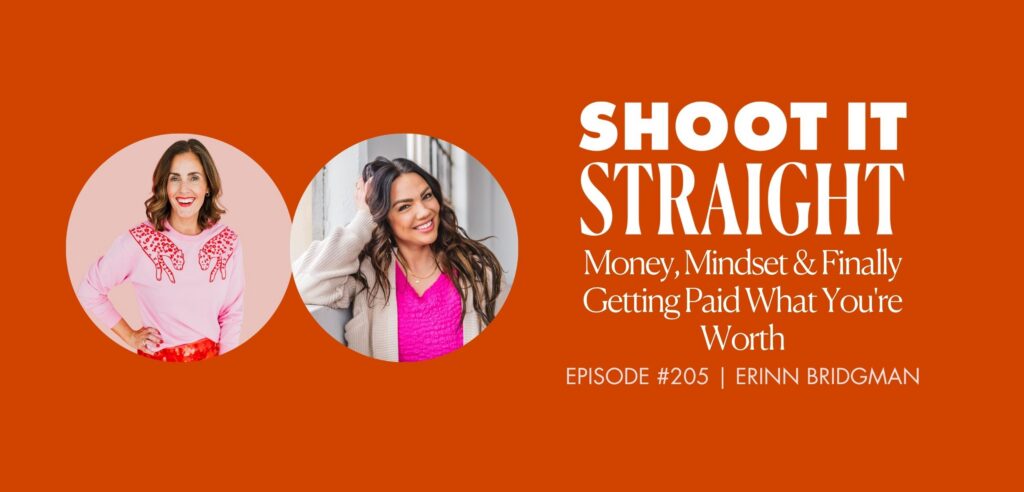
Feel like you’re constantly working and still not making money from your business? In today’s episode, I’m chatting with money and business coach Erinn Bridgman about why that might be the case. We’re getting real about how you can have success in your business but still feel broke, plus how to actually get on top of your financial stress.
The Shoot It Straight Podcast is brought to you by Sabrina Gebhardt, photographer and educator. Join us each week as we discuss what it’s like to be a female creative entrepreneur while balancing entrepreneurship and motherhood. If you’re trying to find balance in this exciting place you’re in, yet willing to talk about the hard stuff too, Shoot It Straight Podcast is here to share practical and tangible takeaways to help you shoot it straight.
Make sure you’ve hit that follow or subscribe button on your favorite podcast player to get notified each week as we air new episodes!
Subscribe on Your Favorite Podcast Player
Apple Podcast App | Spotify | Amazon
Review the Transcript
Sabrina: On today’s episode of the Shoot It Straight podcast, I’ve got my friend Erin Bridgman, and we are talking about money, not just from the perspective of how to make more of it, but really how to keep it. And there’s a lot of real juicy meat in this conversation about why we feel stuck with money, why we always feel broke, why we can’t or don’t pay ourselves regularly, the pieces that we’re missing for those parts of being a business owner, but also our personal finances.
This is such a great episode for everyone, no matter how you feel about money. If you think you’re great with it or not, there is something for everyone today. I can’t wait for you to hear this episode, so let’s dive in
Welcome to Shoot It Straight, the podcast for women building businesses and lives they actually want. I’m Sabrina Gebhardt, and around here, we believe in clarity over hustle, alignment over burnout, and giving yourself permission to want more, more ease, more beauty, more income, more space to live. So if you’re ready to grow without losing yourself in the process, you’re in the right place Welcome back to the Shoot It Straight podcast, my friends.
Today, we’ve got a really fun guest. She’s new to the podcast. I have met her in the conference circuit several times over the last few years, and I’m really excited about kind of where we’re going today. We talk a lot about burnout and marketing and building a business that doesn’t, like, drain you.
That’s what we talk about a lot on this podcast. And I also love to talk about money, but it’s been… It’s been a minute since we’ve actually done that. And so today, we’re gonna go there, and not just about making money, but about keeping it and letting it work for you, which is awesome. And my guest today is the real deal.
Again, I’ve met her at conference, and she went from being a wedding photographer to building, like, a massive real estate portfolio, and she teaches about money. And I cannot wait to have her here. So my friend, why don’t you introduce yourself to the audience?
Erinn: Hello. I’m so excited to be here. Thanks so much for having me.
Yes, I’m Erin Bridgman, and I was a wedding photographer for six years, so I know the photography world well, and I know the highs and lows, especially with cash. And, uh, we were able to purchase our first real estate investment in 2014, specifically from the extra money we made in photography, and that’s kind of what spurred us into be- being self-made millionaires and, um, my deep passion for helping creatives not be afraid of numbers and money, but understand that it’s the key to bringing so much of what we desire, like freedom and impact and security and things like that.
Sabrina: Yeah. I love that. So I wanna hear a little bit more of your story. I’ve heard it before. Um, I’ve heard you speak before, but I want the audience to hear it. So going from wedding photography and knowing, like, the ph- the actual internal workings of being a photographer and, like, the stuff we struggle with and the stuff we do and where our money goes and, and all that mess, how did you go from shooting weddings to becoming, like, a money coach for creative entrepreneurs?
What was the moment that changed kind of the trajectory for you?
Erinn: Yeah. So I actually moved into business coaching in 2018. So I, um, was working in higher education, kind of was done doing that in my career. I had gotten certified with the StrengthsFinder assessment, so I was doing some, like, coaching, eh, consulting stuff on the side.
And back then, my business coaching was really focused on helping you make more money. And as I was doing this, I was like, “Hey, I scaled to six figures in photography in two years. I’ll help you make more money.” I was realizing that we were doing that beautiful work of helping people make more, but it was- I almost, I felt like a disservice because then people were like, “Okay, I’m making this money, but where is it going?
And I have this debt, and I ha- I don’t have a budget. I don’t know this.” And, and I was just started to like on the spot create tools, create like spreadsheets, thing- things like this, ’cause I’m, I speak creative and I speak nerd. I’m kind of like both And so I realized, oh, this is like a total need for people is not, not just making more money, but making more of the right kind of money, and then really being able to kind of f- plug the holes in your money management system, which is something that’s like very unique to, I think, creative entrepreneurs who have seasonality in their business.
They don’t have a predictable paycheck, and so where are we learning that financial education? Uh, how do we learn how to manage it? How do we learn like the unique aspects of being an entrepreneur? So you might be able to have really high return on certain investments inside of your business, and you have a higher risk tolerance.
There’s all different things that like the traditional financial coach isn’t going to be able to like understand or really help. So I kind of fell into it just by s- noticing the need and just like creating that and then seeing, oh, this isn’t just like a one-off thing. This is something like kind of prevailing across the industry.
Sabrina: Yeah. Yeah, exactly. Uh, I hear all the time from the women in my community, whether it’s in my membership or my mastermind or just in my DMs, that, you know, there’s so many photographers, family photographers, wedding photographers, branding photographers, and they may be, quote-unquote, “fully booked” on paper, right?
They’re, they’re doing the work that they love. They are so proud that they’re like actually a photographer, right? That they’ve like made it, so to speak, but they’re still stressed about money. Why do you think that is? And is there something specific about creative women that makes money avoidance like go hand in hand?
Erinn: Yeah. I think that there’s like a couple things at play. So I think there’s, for one, I think a lot of us fell into the art of photography. Like we were artists first, or we picked up the camera, and we were like, “Oh my gosh, I actually really love this, and I’m kinda good at it.” And then like you do it for your friends.
And then your friends’ friends start to pay you a little bit of money. And then it like evolves into this like, “Oh, I like have a legit business.” And then maybe you’re like quitting your other job. And so you didn’t necessarily get into photography because you were like, “I have a business plan, and this is what I wanna do,” and you w- you fell in love with the art of photography.
And so I think that that’s a piece of it, right? You didn’t necessarily like get any education in business or finance or y- those are now the hats that you have to wear. I think that’s a piece of it. I think particularly if we look at women, and we look at women in the context of history and with money, it’s very clear that the shifts around money are very, very recent.
And I, I like, like to point this out because I think it’s almost like shocking. Like we kind of forget, but it wasn’t until like the 1970s, right? That a woman could open a credit card without a man. And like, I mean, this is like bi- le- less than 100 years ago. I mean, that’s just like a couple generations.
And so the patriarchy that is in society and the, the way that women are spoken to about money, predominantly like in media for example. Like, it’s always about budgeting, spending less. But when media speaks more to men, it’s about investing, it’s about making more. That’s what’s gonna actually build wealth, not spending less money.
And so there’s a predominant like narrative around women and money that goes even beyond like being a creative that I think is important to put context to because I say that then that shows like you doing the money work is you stepping against like a whole sort of societal structure. No wonder it’s hard, but also do- in doing that we’re really shifting history and we’re making massive change.
While each of us has a money story that’s particular to us and, and shapes like our money beliefs and our money wounds and our money gifts and strengths, we are a part of like a greater narrative as women that I think is important to like notice and observe. So I would say like a combination of those things, a lack of education overall for, um, women, uh, for particularly like entrepreneur women.
Obviously more and more women are going into entrepreneurship. The shift in like, you know, predominantly maybe being more at home versus now having careers. All of these things play a part in where we sit now and in our relationship with money.
Sabrina: Yeah. I, I think it’s so true. I have a personal rule where I like will not take any kind of financial advice from a man.
So like I… That’s like a hard stop for me. I don’t, I won’t follow them, I won’t read their books, I will not work with somebody in that way. Like, it’s women only. Like, this is a girl gang, right? I wanna read books written by women, I wanna follow women who are leaders in this space. We only work with like investment advisors and tax professionals that are women.
Um, because of that, I’m like, “I don’t want to hear the sad, old story. Like, stop telling me I can’t have my lattes and go shopping when I want,” right? That’s not, that’s not the issue, right? You would never tell my husband that, right? Um, and so I, yeah, I agree with that so much. And I’m, I am really thankful that we live in a time where there are so many women leaders in the space.
Like, it… They’re not hard to find anymore. They’re really not, and, and we’re so lucky because even 15 years ago they were. Like, 15 years ago it was like Dave Ramsey or, or no one else, you know? And now there’s all of these people that have come out, so many are women, and, uh, you know, I like to point out the good parts of social media when I can, and this is one of ’em.
Like, there are some really awesome badass women in the financial space on social media. You just go find ’em and go follow ’em, you know? So again, I kinda wanna dig into this even more, the, like, looking successful on paper. ‘Cause I just said about social media, right? We can have a business that looks good on social media, right?
We’ve got clients, everybody’s pretty, th- everything’s styled, our images look good. We’re saying that we sold out of this thing and sold out of this thing and we’re booking months in advance. And right, all these things can look so good from the outside, and your clients can be happy and everything can be, like, green lights, except you still feel broke.
You still feel like, “I’m working all the time. I’m making good money.” Maybe you’re really happy with what you’re charging, and you’re doing all the things right. But where’s your money? What’s happening to it? Like, why, why do photographers struggle with that so much?
Erinn: Well, I think that you’re s- you’re naming a narrative that I think is important to, like, most people don’t talk about it.
It’s like this underlying, right? ‘Cause it can be very, like, shameful, embarrassing, right? And it, I, I realized, obviously, in my story, like, oh, this is, like, a predominant thing. Like, this isn’t just, like, one-off, like, this is a lot of people coming, like, coming out of the woodwork being like, “Oh my God. Yeah, that’s me.
Like, I’m, I’m that. I’m this person in my community, or I have this reputation in photography,” or I work with wedding pros as well, so wedding planners and things like that. So I think it’s just helpful. I always wanna say for those who are listening and they’re, like, feeling that they resonate with this, I just want you to know, like, you’re not alone.
And I think o- the biggest way to keep ourselves in shame around money is believing that we’re alone. And so when we start to have these conversations, it’s really beautiful because then shame has to, like, move out of the way because we’re not alone. And so I just wanted to make that a, a moment and say that I think that when it comes to what the part around money and numbers, most of the time we think that, okay, if we hire a bookkeeper, if we hire an accountant, we have our money or our numbers under control Even though, ugh, it’s really sad, but like a lot of people’s accountant relationship sucks.
Like, they’re like, “I can’t even talk to my accountant. They file my taxes. They, I don’t feel like they’re helping me. I can’t get ahold of them.” ‘Cause I’m not an accountant, right? So I’ll be like, “Okay, this is my advice, but let’s like verify with your accountant.” Like, I can’t even get an answer from them in a month, you know?
The, but the bigger problem is both of those people are designed to hap, help with the present to the past. So a accountant is making you obviously compliant with taxes, dealing with numbers you’ve already created, you’ve already done. And the same with a bookkeeper who’s basically, you know, organizing your transactions.
This is money you’ve already made, money you’ve already spent. And the more important picture when it comes to numbers and finances that actually like changes the ability to feel more of the money, make more of the money, transfer into your personal world, is numbers that are present to future And that’s actually so important when you have volatility in your revenue.
So when you have slow seasons, which most photographers, unless, I don’t know, you’re, like, in Hawaii or something, like, we have, like, winters, and we have, like, slower times, and we have the fall that’s insane. And so you have to really be able to see a full cycle. So when I work with people, we, we do a present to 12 months plan because this allows you to then see, okay, what is my cash flow?
And cash flow is, like, the balance of your accounts months and months out. Because in October, you might feel really rich, and you might have $25,000 in your bank account, and you make decisions based, based in a very present moment of that account, not realizing that you’re actually spending money for February.
So if you don’t have the management piece of future-facing, you’re not able to make the most strategic decisions that comes from salary is the most important number. And keeping a consistent salary is crucial to building personal wealth. Because one of the things I teach around money is the importance of automation.
Because this, this kind of, like, removes some of the emotion and human element around money, and 80% of money is behavior and 20% is math. You can’t put on auto, you know, $650 a month to your Roth or $300 a month to savings or whatnot if you don’t have a consistent paycheck. That’s a huge piece. Planning future, we don’t really have that.
There’s a lot of decisions that need to be made from a data perspective that can be, like, analyzing your revenue for profitability. Like, you might feel great about your prices, but are your prices really paying your paycheck? Like, some packages might really be doing that, and some might be really deterring from that.
Or you might choose to make some investments that are really good o- on ROI, and then you might choose to not be making investments that you should, or you’re making investments, and they don’t have good ROI. And so that’s another big piece of if we’re avoiding the numbers or, like, kind of, like, avoiding looking behind the curtain there, that’s really impacting our cash in our pocket And you might be photographing the most beautiful thing.
And a lot of this, like when I work with people at the very beginning, we do like an expense audit, and a lot of times I will fi- I’ll uncover like hundreds, really like thousands from an annual perspective of money that’s literally just like, “Oh my gosh, I didn’t even know I still subscribed to that,” or, “I’m not even utilizing that, but I keep it just in case.”
And so, yeah, I, I guess that’s my little spiel on that.
Sabrina: I, um, totally agree with you on the like accountant and bookkeeper thing. I, so I was a photographer for 15 years, and I had one of those people who just like did the numbers, filed the thing, and that was great. And at the time, that’s like what I needed the most, right?
I wanted to know that I was like legal and everything. But there gets to be a point where you need more than that, and I’m lucky enough that I work with somebody now who I have monthly coaching with her in addition to bookkeeping. And so she do- we do cash flow every single month, and we get in there and we’re able to see like, well, what happens if I launch this thing?
Or what happens if I sell more of this or less of this or whatever? And I’m able to see, oh, I’m gonna be okay for three months, but then it may get a little sticky. Or, oh, I’m fine for however long. And the freedom that comes from that and knowing that like, like you said, my paycheck is taken care of, you know, all of my expenses are taken care of, and everything is so freeing.
But it’s having that forward vision of what’s coming. And so those people do exist, but you have to find them because it’s not just, quote, unquote, hiring a bookkeeper, right? Because like you said, a standard bookkeeper is gonna just run your monthly numbers, send you a report if you’ve got sales tax, you know, and that’s it really.
Yeah. So I wanna talk about, we, we kinda touched a little bit on paying ourselves. This is so… It is shocking to me how many photographers don’t pay themselves or pay themselves randomly and sporadically just in the form of taking random distributions, right? And it’s like you said, maybe they have $25,000 sitting in their bank account in October, and they decide to take out 15 of it for Christmas holidays and booking a vacation.
And then they are immediately stressed out come January 1 because everything’s empty, and there’s no bookings, there’s no inquiries because it’s post-holiday quiet, right? So how can we get Out of that. Like, what does it look like for a photographer to get away from just pulling the random dollar amounts out when they feel like they can, and get into that proactive situation?
And, and I do wanna add at least what I have heard when I talk to some of my students about this, they get hung up on the, “Well, I want to pay myself $3,000 a month, and I can’t get there.” And I always try and push back, and I’m like, “Why are we starting at 3,000? Why can’t we start and, like, creep up to something, creep up to that instead of having to…”
Anyway, so I, I’d love to hear what you have to say on, like, what switch has to be flipped so that they can get into a place with regular paychecks instead of the random distributions.
Erinn: Well, a couple of things. One, I’d say I love how you said, “Why do you have to start at 3,000?” And I teach, like, if you’re listening to this and you’re currently not paying yourself anything, like, you can put $100 on auto-transfer from your business to your personal.
Now, is that going to make you wealthy? No, a hund- but what’s happening is you’re forming a habit, and you’re energetically, like, saying, “I’m going to pay myself, like, and I’m gonna prioritize that.” Because what I see is from a, like, subconscious state, you’re basically making sure everyone else and all other things are paid for before you pay for you.
And so you’re basically saying, like, you’re the last priority in the business. And from a, like, subconscious level, that’s not really, like, helping. And I wanna point out what you talked about when you talked about your bookkeeper and the forecasting and what that does for you. You said it, like, makes you feel really confident.
It makes you feel… When you’re in that energy of confidence, you make- decisions out of abundance, out of, like, strategy, not out of fear and scarcity, which then will just continue to perpetuate more money coming into your world. It, they work together, the management of the money and the energy around money are together.
So then you’ll, you’re gonna be like, “Okay, like, I feel, look at this coming in, and now I’m gonna, I feel really, like, good. I’m gonna market this new thing,” or, “I feel confident to raise our prices,” or, “I feel confident to go, you know, normally I get these branding deals. I’m gonna go for that,” whatever the case may be.
And d- so they really work together and compound. That’s important piece, too, ’cause it’s not just about the management. It’s about, like, how you change your energy and your relationship with money, and that you gotta work on both of those at the same time, and all my work is kind of doing both of those things because so much of money is our human behavior, which starts with our thinking.
Another huge piece is I like to flip the script on, on its head when it comes to this. So most people, when they set their financial goals, they set it around revenue. And revenue is, like, the really sexy number. It’s the one that says, like, “I’m a six-figure, multi-six-figure entrepreneur.” And even when I’m working with people and we’re doing initial goal-setting, and I’ve even done some of my training and talked it through, they’re still very hung up, “Well, I wanna make $250,000 this year.”
I’ll walk them through one of my tools, which is where we look at, like, okay, w- we’re prioritizing based on your pay. It’s pay first, and then we figure out from there. So, like, what did you pay yourself last year? What are we going to pay you this next year? And why? What are, what’s the motivation? Is it we’re building savings, investing, all, all those types of things?
And then let’s see what your business needs to do. And I just did this recently with someone, and th- they had this number of, like, 250. And I was like, “Well, if we look at this and we can see your growth of your company and we can see this, this all seems … You only need to make 189,000.” And it was still like, “But I wanna make 250.”
It’s like, oh, that’s not the point. The point is not that number. And so we really have to start with, which is, it’s crazy, but, like, that, that’s such a foreign concept. Uh, the amount of photographers or, and/or wedding pros that are almost working for free is, like, insane the amount of time that goes into it, right?
They … This will end up not serving you. You’ll end up burning out. You’ll end up resenting your work, resenting your clients. You’ll end up not being able to sustain yourself in the industry longterm. And so it’s actually of benefit for you to prioritize yourself because then we can be healthy in the business, we can continue the business.
Money is energy, and so we, we have to treat it that way.
Sabrina: Uh, I totally agree with what you said, like, that we’re thinking revenue first instead of, of what we’re taking home. And it’s crazy because the amount of photographers that I have talked to about, “Okay, well, let’s dial it all the way back down to your pricing.
How did you come up with your pricing?” And they’re not even taking into consideration their paycheck. And I’m like, that needs to … That’s, like, the first thing. Like, what do you wanna make this year? And then let’s add in your expenses, and then let’s add in the hours and all this, and that is how you come to your packages or your hourly rate or however you structure your pricing.
And it’s crazy that so many people don’t even do that. And I’m like, no wonder you’re not paying yourself. You’re literally not accounting for your entire paycheck. You’re just taking these random dividends when it looks like you have money, and you don’t because you didn’t account for it, so starting with pay first.
And that’s where, like you said, you get to choose what your goals are, right? And they don’t have to be … You can have very lofty goals, but you can also start really small. Maybe the goal is that you wanna be able to pay for groceries, that you don’t wanna have to … that to come out of anything else, or you wanna pay for your kid’s daycare or your kid’s summer camps or whatever it is.
Your goal doesn’t have to be huge, right? It can be someday, and I love that for you, but, like, if you’ve never thought about this and prioritized making money and bringing it home to your family, like, what’s the goal for that first, right?
Erinn: Yes, and it needs to be exactly what you said. It needs to be specific.
So when you talked through that, you said it’s groceries or it’s child’s camps or vacation, whatever it might be. That’s very different than a random dollar amount. And I always say piles of green cash are not inspiring. It’s not ins- okay, I’m gonna make… That’s why, like, $250,000 is, the only thing inspiring about it is kind of it’s impressive, and it, like, makes you feel like you have something that, like…
And you do have something that’s working at some level, right? But what would work way more is if we’re, like, making sure that the pay is there, too. So be- making sure that there is a, like, intense motivation around it for you is what will help you show up in the hard times. Things around looking at your money and stuff like that.
Like, okay, well, would you rather stay in debt, or would you rather, like, do that work and pay off your credit card in the next 12 months? Like, I’d pick the second.
Sabrina: Yeah. Hav- I think having a really specific goal is so great. And going all the way back to where you said, like, even if you just start paying yourself, like, having the auto draft of, like, $100 a week.
Sure, that’s not a huge, sexy number, but when you’ve gone from only pulling out money when you, quote-unquote, “feel like you have enough,” and maybe you need it, to having it drip into your personal account, even if it’s just funding your nails or, you know, your monthly whatever it is. It can be the smallest thing, but it’s the energy of, like, my business paid for this.
My business is, like, helping support my family or things that we want to have or do. It is, it completely shifts the perspective from, like, supportive, like- Proactive and reactive, right?
Erinn: Huge. It’s huge. And this is all, this is all based on, like, habit formation. Like, change that is sustainable, that actually, like, moves is not you going from waking up in the morning at 7:30 to going straight to 5:00 AM.
It’s, okay, this next week I’m gonna wake up at 7:15, and I’m gonna do that for a week, and then I’m gonna do 7:00. I’m gonna do that for two weeks. That is when, over time, now you’re also building, like, support structures around that. Oh, you’re going to bed a little bit earlier. You have better, like, sleep hygiene.
You’re not looking at your phone. You know, all of those pieces that you actually, like, need to have happen in order to keep it going. And so you doing the $100 is an energetic move. It’s a habit move. And it’s, like, an identity shift because now your business is not just, like, the… Like, oh, this hobby that sometimes…
No, you’re prioritizing you and paying yourself.
Sabrina: Yeah. Exactly. I mean, that’s where profitability comes in. Like, you can be profitable even if it’s just a little bit. You know what I mean? And that’s where we’re going from having this really expensive hobby that looks good on paper, that do- that’s not actually a business to being…
‘Cause, I’m sorry, if you’re not paying yourself, you’re not a business. I’m, I’m just gonna throw that out there. Like, if you’re not paying yourself, you have an expensive hobby, and that’s the difference, right? And y- like you said, the, the energy of when we are in abundance and we do make those decisions confidently, this is part of that, right?
When you know, even if it’s just $100 a week, but when you know that you are regularly contributing to whatever it is that you wanna con- contribute to, it’s the, like, I’m putting on my big girl pants and I’m putting on my blazer and I’m, like, legitimate, and you’re making decisions from that place of I am a successful business owner, not just a hobbyist who’s bad with money.
Okay. So more money is not always the answer, right? We, uh, so many people are like, “I just need to raise my prices. I just need to raise my prices, and then all the money woes will be taken care of,” or, “I just need to book more sessions, and all the money woes will be taken care of.” And that’s not actually the answer to financial stress, right?
So why is that not the truth?
Erinn: Here’s the problem. There’s a lot of problems with this, but one is we’re trying to avoid the thing that we actually need to look at in order to make the change. So if you’re saying, “I wanna, like, basically, like, make more money,” it’s because you wanna feel more of the money in your life, right?
But you’re not actually, like, conscious around your money. So I teach alignment versus restriction when it comes to any sort of like budgeting, okay? And you can’t find yourself in alignment or like not alignment if you don’t know what’s happening. So that’s part of the problem. Like, when you’re out of control with money, it doesn’t feel good.
So you might be like closing your eyes, hoping for the best, it always works out, but honestly you feel like crap Because you don’t really know where it’s going. You don’t, you just kind of like ho- close your eyes, hope for the best. It doesn’t feel good. There’s this constant hum of anxiety in the background, and you think it’s freedom to be able to swipe your card, do this, do that, pay for the dinner out, the drinks out, the coffees, whatever.
But then a lot of times what happens when we start to become conscious around our money, which we’re afraid to do, ’cause we’re afraid of what that will show us, but that’s necessary to get in the seat of control. And so you might make more money, but with that money might come more money, more expenses.
You might then make a shift, like I’m making more money, so you get a little more swipey swipey. And I’m all about living the bougie, luxurious life. I have a beautiful life. I am so grateful, and I want every woman to find that, like, whatever that is for them. But I say, like, w- let’s, there’s someone, for example, we did this work, and she found out she was, um…
We labeled it, like, shitty gas station snacks, and it was like $200 or $300 a month. This was her living out of, like, convenience and not alignment. Like, it was, she didn’t like that she was spending that. And so there’s probably a lot of things, because you’re unconscious, I’m assuming you’re unconscious around your money and your spend at this point, that is actually not freedom.
It’s actually not alignment for you to spend that way. Freedom is when you actually know where it’s going, decide where it’s going, and make the shots. Basically, I’m saying you can’t avoid looking at the numbers and really figuring out what’s going on. And I promise you, if you do that and you, you, you keep the right head on your shoulders, you will feel so much better than you think you feel now around money and just kind of freely spending, if that’s the case for you.
Sabrina: I, I could not agree more. We have a, like, a really, probably a, a normal money story, my husband and I do, and it’s been a long road to get to where we are. And first I prioritized, like, getting my business cleaned up, and then it was our personal life. And there were a lot of moments where it was like, “What in the hell is actually happening here?”
Where I was pissed, I- quite frankly. You know, I was not scared anymore, but I was like What do you mean this is what we’re doing? You know? And it’s not pretty, but you have to get in there and say, “Okay, enough’s enough. I’m taking control of this.” And then it is so freaking freeing to know that, like, like you said, we get to call the shots, you know?
And it’s not perfect all the time. There are definitely seasons where we fall out of alignment because of whatever, life happening and things happen. But being in control most of the time instead of being out of control all of the time um, is definitely where you wanna be, for sure.
Erinn: And I feel like in the process, you have to be so gracious with yourself.
Sabrina: Totally.
Erinn: Because as women, I, I, I take a watercolor class. This is just, like, a fun thing I’m doing. And it’s so interesting because we are making actually, like, pretty beautiful pieces, and all of us, I hear us like, “Oh my gosh, I, I said it. I hate how my, like, my ink kind of bled here,” or, “I hate this little…
Ugh, this, this one…” This g- my friend, she’s like, “This one line I did wrong.” And we’re so, we’re, we’re so self-critical. And we’re even… Well, I mean, when now we’ll take it from watercolor to money and take it to, like, okay, we’re looking at, like, we’re being exposed. I mean, where you put your dollars is where you put your values.
And so right now you might be putting your values towards, like, feeling good even though y- like, convenience, like, whatever. And so you need to be gracious with yourself in as you start the process of looking, saying like, “Okay, this was a different, this was the version of Erin that didn’t have this education, and so I thought that was a good decision, and that wasn’t a good decision.”
Or, “This was the version of Erin that was scared, and so she…” You know? And so I just wanna say that I think it’s really important that you are kind to yourself and gracious to yourself as you do this work, because shaming yourself and, like, getting r- is only gonna keep you in, in a, in a not happy relationship with money.
And we want happiness in that relationship because then we can bring more of it into our world.
Sabrina: Yeah, I agree with that. I would much rather someone say, “This is gonna be hard, but I’m gonna do it anyways because I’m brave and I’m a baddie and I can do this,” as opposed to walking into it with, “Well, I know this is gonna be a disaster and it’s gonna be terrible and I’m gonna be so guilty about the past choices I made,” right?
Because you can do hard things. And numbers are not easy for a lot of people. But also, I will say that we live in a world now, thank goodness in 2026, where we’ve got Spreadsheets and all kinds of apps that can download things and sync things and coordinate things. And I think it’s easier now than ever to dig in and look at our numbers, you know?
I don’t think it’s nearly as scary as it was back in the pen and paper ledger days. So it’s actually not as hard as you think it is, um, to get everything pulled together. And I think it’s… I think we’re speaking the same language. I think it’s kind of an unwritten rule that, especially for solopreneurs, looking at your business is one thing, but you really need to do it hand-in-hand with your personal, because it goes together.
There’s… It’s such a fine line. And so really I’m… we’re saying it’s time to dig into both.
Erinn: Uh, I, I do both with my clients, and the reason I do both is because I’m about helping you build personal wealth. And so we can’t do that. You can’t do it to the detriment of… Like, you must have a business that pays you consistently, which means we have a lot of, like, money work to do there.
And then you have to… If it just goes into this abyss where, okay, now we’re putting $1,000 extra a month into your personal world, but that’s just not, that’s not directed anywhere, there’s no strategy behind it, then we’re not really helping, you know? So yeah, you, you gotta do both. And often, like, the habits in one area of your life are gonna be the same in the other.
And so w- if we’re gonna do a holistic, like, tune-up of money in your life, you gotta do both.
Sabrina: Doing one is gonna make doing the other easier. Like, it… you’re just gonna grow all the way around, you know? Um, which is good. So let’s, let’s ta- let’s take it to a practical thing. I love to end podcasts with, like, a practical step.
So we’ve got photographers listening and they’re like, “Yep. I’m feeling overwhelmed. This is me. I needed to hear this today.” What is one thing that she can do this week to start getting a better handle on her money?
Erinn: So awareness is our first step to change. Becoming aware. You can’t change something that you don’t really know what it is.
And so a couple things. One, I just published this quiz. It’s called the Money Glow Up Quiz, which is really fun, and it’s gonna help you uncover, like, where you’re at with your relationship with money and your re- your journey of wealth. There’s five different stages, and it sort of illuminates where you’re at and what to be focused on, what to be working on.
So I’m excited to share that with your people. But I think also just identifying what is another small step of awareness that you can take. Is that, like, looking at your bank accounts every day? Is that, like, logging into the credit card and actually seeing the balance of your debt? Is that… You know, what is the one small thing that you can do to bring a consciousness and awareness around money in your life?
And so I gave a couple of examples of what that could be, and that’s my encouragement too. I’m super action-oriented as a coach and as a person, and so, um, use your own creativity of where you’re at in the money journey, and, um, that would be my sort of piece for them.
Sabrina: Okay. I love that. I think that’s such a good place to start is just, just look.
Just go, go in the closet. Just open, you know, like open the door, open the, open the statement, whatever, and just look at every single line item, and become aware. And like, like you said, no guilt, no shame, no anger, just, just do it. And if you feel a certain way about it, just know that you get to change it, you know?
And you’re looking at, like you said, past data. It doesn’t have to be future data. Um, so I think that’s really, really wise. I am super excited about this quiz that you created, and I’ll definitely share the link in the show notes for everybody. That sounds so fun.
Erinn: So fun. People are freaki- people are like, “Oh my gosh.
That’s like me to a T. How’d you know?” So it’s working so far.
Sabrina: Okay. I love it. I love it. We’ll definitely have that in the show notes. I knew this was gonna be a really, really great and insightful chat, and I’m so glad that you could bless us with your time today. Will you let the audience know where they can find you and connect with you?
Erinn: Yeah. Best place is Instagram, so that’s where I’m super relational. I like chat in the DMs, so if you heard me on this episode and you’re following me now, just like literally send me a DM. I’d love to hear, like, your biggest takeaway or, like, just start, start a conversation. So it’s… My name’s spelt really weird, so definitely check the show notes, but it’s Erin with two Ns, Bridgman like a bridge and a man, but no E on Bridge, so hence why you should check the show notes for my actual name.
Amazing. But that’s what I am on Instagram.
Sabrina: I love it. Erin, thank you so much for being here today, and my friends, that’s it. We will see you next week. Thanks so much for listening to the Shoot It Straight podcast. You can find all the full show notes and details from today’s episode at sabrinagebhart.com/podcast.
Come find me and connect over on the Gram at xo.sabrinagebhart. And if you’re loving the podcast, I’d be honored if you’d hit that subscribe button and leave me a review. Until next time, my friends.
Review the Show Notes:
Meet Erinn (1:43)
From wedding photographer to money coach (2:44)
Why you’re still stressed about money (5:15)
When you have success but still feel broke (10:11)
How to actually pay yourself (18:26)
Why more money isn’t always the answer to financial stress (28:21)
One thing to do this week to get a better handle on your money (36:39)
Mentioned In This Episode:
Your Money Glow Up Quiz: go.erinnbridgman.com/money-glowup-quiz
Connect with Erinn:
Website: erinnbridgman.com
Instagram: instagram.com/erinn_bridgman
Connect with Sabrina:
Website: sabrinagebhardt.com
Instagram: instagram.com/xo.sabrinagebhardt
TikTok: tiktok.com/@xo.sabrinagebhardt


Comments +