


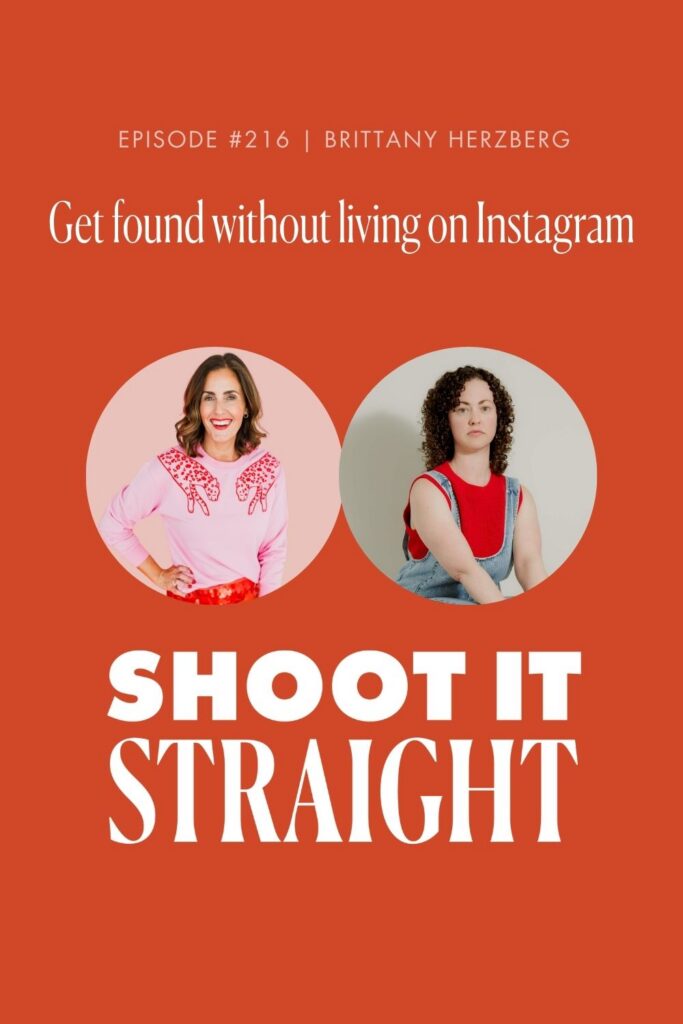
Is it really worth it to spend time on SEO? In today’s episode, I’m chatting with coach Brittany Herzberg about the impact of SEO on lead generation for your business. Plus, how spending just a few hours optimizing your SEO can help you get found without having to live on Instagram.
The Shoot It Straight Podcast is brought to you by Sabrina Gebhardt, photographer and educator. Join us each week as we discuss what it’s like to be a female creative entrepreneur while balancing entrepreneurship and motherhood. If you’re trying to find balance in this exciting place you’re in, yet willing to talk about the hard stuff too, Shoot It Straight Podcast is here to share practical and tangible takeaways to help you shoot it straight.
Make sure you’ve hit that follow or subscribe button on your favorite podcast player to get notified each week as we air new episodes!
Subscribe on Your Favorite Podcast Player
Apple Podcast App | Spotify | Amazon
Review the Transcript
Sabrina: Welcome to Shoot It Straight, the podcast for women building businesses and lives they actually want. I’m Sabrina Gebhardt and around here we believe in clarity over hustle, alignment over burnout, and giving yourself permission to want more. More ease, more beauty, more income, more space to live. So if you’re ready to grow without losing yourself in the process, you’re in the right place.
All right, welcome back to the Shoot It Straight Podcast, my friends. Today we have a new guest for you. She’s not new to me. She’s, we’ll call her new-ish to me. Um, but I found Brittany through my business bestie, Coley James, as I do many of our friends that come to the podcast. And Brittany has already come and taught inside of my membership first class lounge, so I got to know her there, but I knew immediately that she had to come over onto the podcast.
And so it took us some minutes to get here and to get scheduled because life is lifing and things were busy. But here we are. She’s finally here and I’m super excited to chat all things SEO, website, findability and all of that. Brittany, before we get into things, I would love for you to introduce yourself to the audience.
Brittany: So, hi, hello. I’m Brittany Hersberg. Uh, I am your favorite SEO coach that you never knew existed. My happiest place is really just like introducing people to SEO, so all of the like questions that we feel are dumb or stupid, that’s my jam. I really love helping established entrepreneurs who are like, “I’m on Instagram, that’s good.
I have a podcast, that’s good. I wanna stop doing so much. I wanna stop efforting so much.” So that is where your new, beautiful bestie SEO pops in. And I kind of accidentally fell into this. I’m sure we’ll talk about it, but I landed a couple of clients when I was in a brand new state, had, I was the breadwinner for our family and I honestly had no idea how I was gonna pay the next month’s rent because I hadn’t had anybody come in.
People found me, surprise, surprise. Turns out it was Google. Lots of things fell into the right place and I was like, “How did this happen? How can I do it again?” And then once I understood the magic of SEO, I have not been able to shut up about it because it feels like extra credit for business owners, something that we tend to wanna avoid, but it’s really better when we embrace it.
Sabrina: Yeah, definitely. So I definitely wanna hear more of like your origin story. Like what were you doing before you realized, “Oh, hey, like I’m good at this SEO thing and it’s kinda fun for me,” right? Um, and you became a little bit obsessed with it. Where, where did you actually start out? Because so many entrepreneurs didn’t start in their thing, right?
Like it was a winding path to where they ended up. So what, what is your story?
Brittany: I mean, how far back do we wanna go? I’ll take us back to, I used to be a massage therapist and that was what I was doing when I, I was located in North Carolina. My boyfriend and I knew we wanted to move somewhere else. We knew we liked New England.
So we decided to go on an adventure and like Airbnb this life. So we were in Vermont. It was fun. There’s also been a lot of moves and I’m someone who very much likes stability. So there’s also been moments of not so fun. But early on, we were in Vermont. We had been there for about a month and a half. One thing I did do, and really just where I came into this online business owner, even just like business ownership period, is I wanna be clear on my website about who I can help, where I’m located, what it looks like to actually work with me.
And that’s always been my kind of MO is like just being clear because I want that. I wanna know what the parking lot looks like. I wanna know what you look like. I wanna know what door I need to go into, what does the room look like? I just wanna feel comfortable before I even meet you. So that is what I was able to do for my clients.
Before we even left North Carolina, I made sure that my website reflected that I was no longer in North Carolina and that I was now in Vermont. So I didn’t think I even had the room rented where I ultimately ended up working, but it said Vermont. And that was the thing that worked, that I now know was what worked.
I just changed that on my website about being clear about my location. And there’s so much stuff like that, especially for photographers and other service providers who are more location based, that can be like a gold thing that you could do that doesn’t take much effort, that doesn’t take keyword research or anything.
It’s like literally where are you located?
Sabrina: Yeah. I can’t tell you how many times, and I know we’re talking about websites, but even let’s just say on Instagram where I find somebody and I’m like, “But where are you?” I mean, like I, you know, I get tons of DMs from photographers asking me questions about marketing and whatnot.
And I click over to their profile as one does to see what I’m working with before I give them a response. And there’s no location. And I’m like, or there’s no name, you know, because their business name is like, you know, Red Door Photography. And I’m like, “Cool, cool, cool. What is your name?” You know what I mean?
And it’s the basics that we often just, we’re s – we’re too close to it, you know, like we’re too close to our business and we’re like, “Oh yeah, why is my name not listed anywhere?” Like it seems so obvious when someone points it out. So I love that you said like location, like how easy is that?
Brittany: Yeah. And I wanna stay with that too for a second because SEO isn’t just on your website and you hit on that and I don’t wanna like steamroll past that because people are like, “Oh, my website’s fine or I don’t blog or whatever, people talk to me on Instagram.”
You can optimize that. And yes, please, location, name, what you do. All of these things can go in like really specific spots so that your profile actually works for you, not just your website.
Sabrina: I know we’ll get into this later in our chat, but like all the things need to match. You know what I mean? Like Lord have mercy, have your name on all of your things, your website, all of your handles, all of your thi – have your location in all of the places.
Like everything needs to match so that no matter where a potential client finds you, they know that it’s you and they’re looking at the same thing, right? So we know how you landed into SEO and like kind of becoming obsessed with it and like, like it’s a game, right? Like learning to do the tips and the tricks and getting excited about seeing things that work and pay off.
How did you fall into helping others do that? Like when did you realize that it wasn’t just something that you enjoyed for yourself, but you could make a business out of this?
Brittany: Pretty early on actually, to the point where I was like going to other SEO people and I’m like, “I feel too green. Is this like okay if I go and like do this thing?”
But one thing I’ve realized about myself is that this is just how my brain works. I am very good at distilling information and teaching people how to do it in a much simpler format. I tend to do things like the crazy complicated way, and then I break it down into very basic steps. So people come into my world and they’re like, “Really, it’s that simple?”
I’m like, “Yeah, trust me, you don’t wanna do the tough way. It’s like much longer of a road, more stressful of a road.” That, it’s always been my thing. So if we go way, way back, I moved a lot as a kid and one of my favorite things to do because I was the smart kid, the goody two shoes, the teacher’s pet, like all of those beautiful nicknames ended up on my back.
And in order to be kinda like liked and to fit in and to make friends, I was like, “I’m understanding this stuff. I’ll just share what I’m learning with friends,” to the point. I still feel like some teacher or principals are gonna come after me when I say this on podcasts, but to the point where in middle school, I very distinctly remember like sitting around with kids and I was like, “You can copy my homework, but I’m gonna tell you how I got the answer so you understand it.”
And it worked and like people were catching up and it was really cool. But yeah, so that’s the like very to the point answer is I’ve always been able to teach people things.
Sabrina: That is so cool. You were like the tutor before you were like making money being the tutor. That’s so, that’s, that’s such an incredible skill.
As you know, because you’ve been in my world before, most of Shoot It Straight is female photographers. Lots of moms balancing multiple things. We do have some other creative entrepreneurs, especially the women who are like photographers and something else, right? Most of the time when I get questions about marketing, it’s, “What am I doing on social media?
Am I posting enough? Am I posting the right thing? Why is nobody responding to my posting?” And one of the things that you preach is that SEO is actually the easiest way to bring in warm leads instead of cold, right? Because we know that social media is cold traffic. Why are people so focused on the social media side if SEO is the, is the winning, the ticket, the winning ticket to get those warm leads?
Brittany: I think. I love this question. I think that people are just so focused on the shiny object, on the sexy thing, and SEO is like the nerdy, complicated, in air quotes, coding, techie thing. It is not complicated. The fact that I can do this, people are always like, “Oh, you understand?” I do not. I do not. I freak out if I have any kind of like technical issue that I have to deal with.
My boyfriend has seen it, my friends have seen it. My clients have even seen it. It’s not my jam. So the fact that I can do this, anybody can do this. But I think Instagram is such an easy trap to fall into, also because. I’ll see if I can say this eloquently. I think that so many of us are like, “It’s the complicated thing.
I have to. It has to be hard. Marketing has to be hard. Business has to be hard.” There’s no way that there can be something so simple and easy working for me twenty four seven in the background. That’s just not possible. So I think it’s, it’s the thing we see in our face a lot. It’s the thing that just feels like the right thing to do, and it’s more fun.
Sabrina: I, I agree. It. Social media is sexier. It’s what we see. It’s, uh, we spend more time, we, the consumer, spend more time on social media than we do, like, looking up websites on Google. It, it just, that’s the way it goes, you know? And especially, I don’t know about you, but I, I love TikTok. I love Instagram, uh, you know, to a point.
But when I’m searching for something, oftentimes I will go over there because I wanna see what their public presence is. And, and it’s not. But now that we’ve got AI, like, everything’s pulling everything together. And I, I do. I think it’s just people are there and they’re like, “I have to be here too, and I’m seeing everybody else show up here, whereas I’m not looking at everybody else’s websites all the time.”
It, it feels more in your face, I guess. And like the, like where the cool kids are, you know what I mean?
Brittany: Yeah. And it’s also something, as you’re saying this, I’m like realizing this, it’s the thing where you can see how many followers someone has, and that’s also in your face. So you really do see, “Oh, this is the cool kid.”
But the thing is, like, so many of the accounts that are large, it doesn’t mean that they’re making good money, and it doesn’t necessarily mean that they’re making money just from Instagram. So many people also have a podcast, also have SEO on their website, also have blog posts, also have a team. For so many of us, we’re solopreneurs.
I think a lot of people in your world are solopreneurs. It’s just us, maybe with an assistant or two, but, like, so much is on you. So you feel like, “Oh, if I just focus on Instagram, I can grow this thing. I can blow it up.” It’s not a sustainable way to do it, because you have to effort so much. You have to be there daily, weekly, sometimes even on the weekends.
And then you end up just being obsessed with, like, looking at your phone and doing stuff over there all the time, when you could have blog posts, images, your website, your podcast working for you.
Sabrina: Yeah, exactly. To your point, when we see these accounts with, like, all these followers, sure, a lot of them probably came in from social media, but a lot of them came in from the other platforms.
People found them first on a podcast and then followed them. They read their book first and then followed them. They found them on Google first or heard a referral. Like, they’re coming in. Sure, they’re landing in the follower category, but they’re coming in through something else. So it’s not just that they have this incredible social media platform that is huge, but they have all these other things that are filtering to all of the other things and talking to each other like a really beautiful spiderweb, which is great, right?
Brittany: Totally. Yeah. And I have a really cool story about that because I actually accidentally ended up taking 18 months off Instagram, and my account grew. I was like, “I’m not focused on my feed posts, my reels, my care.” I actually really enjoy being over there because I have fun with it. I love having the conversations.
And so I was like, “I’m getting to the point where I’m feeling a little burnout. What can I do?” I really like having the time on stories. I really like having the conversations, so that’s all I’m gonna focus on. Still had my podcast, still had some blog posts, still was guesting on other podcasts, doing guest teaching, that kind of thing.
And to your point, people were coming over and, like, that was our connection spot. They were coming over there to continue the conversation, and not so much to, like, that’s not really where they were finding me.
Sabrina: Yeah, exactly. And I think that marketing done well is that multi-platform where things are talking to each other.
And I know that the listeners are probably like, “That sounds exhausting.” But to your point, your website and your blog, while it’s not a set it and forget it, it is more of a do the work and then you can tinker with it. It’s not gonna be all-consuming like writing a newsletter every single week or, you know, producing a podcast or whatever.
And it can be just one of the pieces of the puzzle that works for you when it’s done right. Tell me about how great it is. We love the thought of being at the pool, being on vacation, sleeping overnight and waking up and having leads, right? Getting those leads instead of feeling like we are, what we just said, hustling on social media, spending three hours a day creating a reel that one person views, right, and feeling like it’s not working.
But it is possible to be in that space where leads are coming in all the time, no matter where or how or if you’re showing up at all. Tell me what that can be like.
Brittany: I mean, I have stories popping in my head, so I’ll share some of those. Some are happy, some are not super happy. Like, for one example, my dog a couple years passed away, and very sad I was in the throes of grief.
You don’t wanna market. I don’t wanna make a reel. I don’t wanna freaking go in my DMs and Insta – like, I just don’t. No one does. Or it could be, like, you’re sick or something like that’s happening. Having a business that is set up where leads can find your website, fill out a form, and there’s something automated, like, we’ll reference Coley at this point because she has all of our systems conversations.
Having something set up to go ahead and, like, have that conversation, initiate that conversation, make that person feel taken care of, that is such a better experience when something crappy like that is happening. So that’s one example. I had on the topic of being sick, I had a client, Courtney, she’s a sober coach, which is just incredible.
I love it. She’s, like, really impacting women and kids and families’ lives, and she ended up sick between her and her son. The two of them were like, “I’m down, no. I’m down. No. I’m down.” She took three months where she wasn’t posting to her podcast. She wasn’t posting on Instagram. She had leads coming in. I think at, at the last time I remember checking with her, it was, like, three or four one-to-one leads that ended up coming in and converting into clients while she was, like, laid up in bed for about three months.
That was incredible. I have another client who wanted to go and travel. So last year, she came into my world, joined my group program, got the SEO set up on her website, started blogging, started, like, even doing SEO for some of her paid products, digital products. She’s a bookkeeper. She and her husband were able to go spend, like, three or four months in South America just, like, bouncing around.
Now they’re building a van, and she’s messaging me, and she’s like, “I don’t have time to blog. I don’t have time to this. But look, I made a digital product sale. Look, I had this client find me.” And it’s just so fun to. I love working with moms and I love working with people who just have a lot of stuff going on, because this thing gets to help you.
It gets to market for you. It gets to be that beacon of light that’s, like, sending out the signals, because people are looking for you. We’re all convinced no one’s looking for us, and it’s just that they’re not finding you right now because your stuff isn’t set up for it.
Sabrina: That’s the frustrating thing, because I, I’ve been in business, this business, for 15 years, and I’ve had times where things were done the right way, times when things were not done the right way.
You know, there’s been various websites and platform changes and whatever. We won’t get into all the backstory, but I can speak to how frustrating it is to be like, “But I’ve been in business for two years, and my website is not getting any traffic,” because you feel like you put so much time and effort into that dang website, right, to make it look good and to make it whatever, show up, and to know that it, it really is relatively small things that were missed or done not quite optimized the best way that will make all of the difference in the world where it could have been working for you this whole time, you know?
Brittany: Yeah. It breaks my heart to the amount of people that come in my world and they’re like, “I hired a website designer who said they did SEO. I hired this SEO person.” And I have to be the one to go in and be like, “Actually, this isn’t following best practices. Your location’s not here. This isn’t working. This is broken.”
It sucks. And the reason I am so passionate about teaching this stuff is because I want you. I don’t care if you work with me. I would love to work with people, but I want you to know what to look for so you don’t get taken for another ride, because once you’ve gone on one ride, you’re like, “That’s it. I’m done.
That sucked. How do I avoid that?”
Sabrina: And it’s unfortunate that it. I’ve been in a similar situation recently, not with SEO and websites, but with coaching where, like, people ruin it for everybody else, you know?
Brittany: Yes.
Sabrina: And it’s so frustrating. I’ve said it on the podcast that, you know, I don’t want you to necessarily take my word for it, but not everybody is gonna take you for a ride.
There are people that actually deliver on what they say they’re gonna do. It’s so sad to see when people have been jaded, you know, and screwed out of something, because then they’re hesitant to invest anything or to get any support, and that’s not good either, you know?
Brittany: And the biggest thing that I notice is that their self-trust, it’s, like, eroded with, like, every decision.
So, I mean, I even had someone recently who joined one of my programs, and it was after she had a really, really, really crap experience, like, to the point where she had to go and, like, push for a refund and it was a whole thing. She joined my program, and the, the hugest compliment, like, couple weeks into the program, she’s like, “I already fe- feel like I’ve gotten my money’s worth.
Like, it was so good to just be able to reinvest in something where you’re delivering on the promise.” So, you know, people coming into your world, people coming into my world, it’s like, it sucks at first, and I’m so glad that they get to understand what a good experience is like.
Sabrina: Yeah, and be able to trust their intuition again, like you said, is huge, is huge.
When you coach women, or people, not just women, I coach women. Sorry, guys.
Brittany: Mine is
Sabrina: mostly
Brittany: women.
Sabrina: Yeah, yeah. Well, but I’m not gonna limit you to that. No. When you are coaching someone you have, like, a three-phase process that you go through, and, uh, I’m gonna have you talk through that, but you say that most people are actually doing it backwards or out of order, and so it’s not helping them.
So talk to me about what these three phases are and what the correct order is.
Brittany: So the best order that you wanna go in is start with your website, your core website pages. And if you’re like, “What in the heck are you even talking about?” It’s the ones that are typically in your navigation bar. So home, about services, whether you have one or multiple services pages, even your contact page, things like your free resources, freebies, if you have a blog already, you want that optimized podcast page, you get the drift.
So you want those to be optimized so that they can be different, like w – I. This is the worst example, but it sticks in your head. So all of these pages are like windows and doors into the home that is your business in a very non-creepy, non-threatening way. Like we are wanting people to come and see these windows and doors.
So that’s what you wanna start with first because you need that running first because of the amount of time. SEO likes time. So start with your website pages that can start going out and like marketing for you. Then you want to get into places like your Instagram profile, anything that’s offsite, if you have a directory listing, if you are going and guessing on podcasts, as well as content.
So that content could be YouTube videos, could be podcasts, could be blog posts. All of those can be optimized for SEO. And then phase three, that’s where you wanna be looking at the metrics and the data. So many people are like, “I need to, like, go and nerd out on my Google search console and Google Analytics.”
But you haven’t done SEO on your website yet, my dude. Like go do that first. You have focused on blogs, but you’re not even doing SEO with that really. You need that foundation on your website in place first. So website, anything that’s offsite, like Instagram profiles plus content, and then the metrics tracking.
Sabrina: Uh, it’s so true. People hear about like, “Oh, I can look at my metrics,” and then they go look at it and they’re, number one, they’re confused. Uh, but number two, they’re like, “There’s nothing here,” or they get really disappointed in what they are seeing. And to your point, it’s like, “Well, of course that’s what you’re seeing.
You haven’t done the things first that you’re supposed to do to see positive impact here, right?” Yeah, so I, I love that. And you’re right. Obviously, you’re right. Like SEO takes a lot of time. So focusing, like, putting the time and attention that, because every month that you put off optimizing those pages is another month that it’s not going to be working for you.
And if you’re looking at something that takes six months, 12 months, 18 months, like, you’re just pushing, you’re kicking it down the, further down the road, you know?
Brittany: Yeah. And you’re only hurting yourself, and you’re also not able to help the people who are quite literally looking for you. And they could be looking on Instagram, they could be looking on Spotify to find your podcast.
They could be looking on Google. They could be looking on Cloud or some other AI thing. But if you don’t have the stuff set up, which, like you said earlier, it’s these simple little tweaks. If you’re not taking the time to do that, you’re not going to show up when and where they’re searching for you.
Sabrina: Somebody could very easily say, “You know what? Uh, I need to give myself the time to do this. I’m going to stop hosting in the feed on Instagram for 30 days. I’m still gonna show up in stories when it feels good, not gonna ghost it, but I’m gonna drop all the feed creation, put all that time into my website optimization, and then be able to pick it back up and dive in there while the SEO is, is ramping up and doing its thing, right?
That’s the order that we should be doing it.
Brittany: Yeah. Yeah. And it feels a little threatening and a little bit like I’m sure someone listening is like, oh my gosh, having a very, like, visceral reaction to this. It can feel a little creepy and scary, but it’s just because you haven’t done it before. And again, because we have this, like, do Instagram, do Instagram, do Instagram.
But taking that time. And I do this in Two Weeks Friends with People where I go and, like, work on their website, SEO, the core pages, like I mentioned that first thing. Two weeks. You can even do this in five days. And I’ve seen people do this with children while launching, while rewriting their website copy.
Like, I’m getting to the point with love where I’m like, don’t give me the excuses because we’re gonna be having this conversation a year from now. We’re gonna be having this conversation two years from now. And I quite literally have people in my world where we have had this conversation a year or two, three years ago, and I’m like, “It’s time to do something or stop complaining about it.”
Sabrina: I I say that to my coaching clients so many times. I will literally say, “We’re not discussing this anymore. You know what to do. You can either do it or we can talk about something else.” Because, like, the hemming and hawing around whatever it is, whether it’s a CRM or their pricing or their website or whatever, I’m like, “We’ve had this discussion.
I don’t wanna have it anymore. Y – like, I don’t know why you’re not doing this, just do it already,” you know? Because future you is not gonna be where they want to be unless you do this. And it’s not the most sexy and it’s not the most fun, but it’s absolutely mandatory. Tell me something really concrete.
What can a photographer do? What can they put on their website that is actually going to bring in those warm leads when they’re, you know, in bed reading and a mom is on Google at 10:00 at night?
Brittany: I’m actually going to beef this up a little bit because you can do this on your homepage. And to your point, this is very important for the AI search, like, actually having people come in to be able to find you on AI search results, your homepage and your Instagram profile name.
So not your handle, not the at, whatever, but the profile name. Um, if you go look at your profile, it’s the bold part. Your SEO title, which sounds techie, but just Google SEO title four if you’re on Show It, if you’re on Squarespace, wherever you’re hosting, SEO title for, insert your website host, and you will see where to find this.
It’s a line that you almost want to be, like, a header or a hook, if you will, for, like, a Google search or a, an AI search results page. That needs to be so clear about photographer. We already know that’s gonna be in there somewhere, so photographer, your location, maybe the style or the type of photography that you offer.
So I’m literally thinking off the top of my head, which is a little bit dangerous, so, like, you know, be careful. But let’s say it’s, like, newborn and family photographer in Nashville, Tennessee. That could be your SEO title. You want this to be 40 to 60 characters. You can put this in a Google Doc, you can check it that way.
That can also be your Instagram profile name. Now, one thing I would change on your Instagram profile name is you want your name first. So let’s say this is me, Brittany, and then, like, a bar or a dash or something. Um, and what did I say? Newborn and family photographer in Nashville Tennessee. Like, let’s say that that’s what it is.
It can be that simple. You can go do that with no keyword research. You can do that with maybe, like, minimal Googling. You just wanna save it. You wanna make sure everything is spelled correctly because on Instagram, I think you can change that, like, twice in two weeks or something like that. So check the spelling, but you could be done in 10 or 15 minutes.
Sabrina: Having it match is huge. It is huge. You know, Instagram and searchability wasn’t really a thing 10 years ago, but now it really is. And I, I’ve mentioned this on the podcast before, but, you know, like, you can Google something and Google will show you somebody’s reel, or somebody’s carousel, or somebody’s TikTok, or somebody’s YouTube.
It’s not just web results. And you get more bang for the buck when your keywords match and your names match and all of that, and it really helps the authenti – not the authenticity. What’s the –
Brittany: Searchability, findability, discoverability.
Sabrina: Mm. Authority. Ooh, that – authority. I’ll just
Brittany: keep on saying we’ll find it.
Sabrina: We’ll figure out a word. The authority. It, it helps your internet authority to have all of your things point to the exact same thing. I love that. And that’s such an easy thing. Somebody could literally, like you said, do it in five minutes.
Brittany: Yeah. I mean, it’s so simple. And like I said, it is very critical for especially the AI searchability, because there.
I, I say this, and I’ll keep saying this until someone tells me I’m using the word wrong, but, like, when you have the same stuff on your website pages, your Instagram profile, TikTok, LinkedIn, whatever it is, it helps the bots triangulate you, like, really quickly, which, to your point, does, that is one of the things that they’re looking for when they’re looking for an expert to be able to put in front of so-and-so who’s Googling at 10:00.
Sabrina: So, specifically with photographers, this isn’t the case with some creative entrepreneurs that serve, you know, you serve people all over, I serve people all over. But when we’re talking about photographers, most of the time, not necessarily for weddings or, or commercial work, but for the families and newborns, they are serving an area, like, one super local area, so they really need to be found in that area and then in the neighboring areas around it.
Is there, like, a most common thing that you see photographers’ websites or local businesses’ websites getting wrong as far as location?
Brittany: Yes, just not having it or being really inconsistent. I mean, I’ve even seen people who are based in Ohio, let’s say, and then they move to California and they haven’t updated the location.
Like I said, going all the way back to the beginning of the conversation, before I even moved, I made sure that the new location was in there. So there are a few key places you can put this. One that I see photographers miss constantly are your image titles. For the love of everything, can we all agree just to stop having, like, IMG 4532?
Like, I need us to have words, and we have to use dashes. We can’t use the underscore, we can’t use a period, spaces, anything like that. It needs the dashes because that’s how the bots read things. So image titles being one of them, your footer, you can have this. You could just be normal paragraph text. You could have it as, like, an H3 or H4, potentially, just kind of depends on how the rest of the webpage is set up.
And then, like I said, those SEO titles. So, going back to that, if you’re like, “What in the heck are these things?” Go to Google, type something in the search bar. You could even just be, like, SEO coach or photographer, whatever. Just type something in. Hit enter. You’ll see the Google search results page pop up.
Then you’ll see these blue hyperlinked headlines. That’s your SEO title. So many of us go to these pages and scan very quickly. Have photographer or photography and your location in there. And it could be a state, it could be a city and state. It could be a city, comma, like, you know, Connecticut, could be CT instead of spelled out Connecticut.
It depends on everything else that’s around it, but city, state, state, something like that needs to be in there for sure.
Sabrina: I know that I have seen a lot of photography websites where, you know, they’ll have, like, their H1 or their H2 have, like, a spec – Nashville, Tennessee or whatever. But then at the bottom in their footer, it’ll say, like, Nashville, Franklin, l- like, all the surrounding areas, and it’ll have, like, 20 surrounding smaller towns.
Is that still best practice or is that not really necessary anymore?
Brittany: I don’t know that you need a, like, a large group, like 20. I think the most that I’ve had clients put in is, like, maybe five, three to five, I would say, is a good number, because you don’t wanna stuff. If you’re putting 20 in there, that looks like it’s stuffing it, but just have maybe, like, a few key areas.
And I’ve done this, if you happen to be listening to this, and you’re not a photographer, you can also do this if you’re location-based, so in the footer. Um, but yeah, I mean, that’s still a good thing to do, is to have, like, a few different surrounding areas.
Sabrina: Okay, talk to me about blogging. Uh, you know, we’ve gotta ask, is it still worth it?
Is it still doing anything? Do people still need to prioritize it? Give me the truth.
Brittany: You need to be blogging. Okay. Now that I got that out of the way.
Sabrina: Thank you. Uh, you heard it from Brittany, not me, okay?
Brittany: Sabrina’s like, “I didn’t say it this time.” Yes, you need to be blogging. I like to also then immediately say it can be as little and as infrequently as 500 words in a post once a month.
You can do that. You. Think about how much time you’re spending on Instagram. Like you said, you know, take a week off from Instagram. You can blog. So that needs to be happening. You do need to be saying some of those keywords in the blog posts, especially in your blog post title. Again, was it a photo shoot that you did in Santa Monica?
Was it a photo shoot that you did at a specific place? Like, is it like a garden or a building that people go to, a museum, whatever that is, put it there. The type of session, was it a senior session? Was it a family photo session? Was it a mini session? And then you could even, if that doesn’t really fit the bill, you could put like the type of photography.
So was it lifestyle? Was it documentary? Stuff like that. That’s what I’m talking about. Because people are. We don’t give people enough credit. Like we’re pretty dang savvy right now. The internet is at our fingertips. AI is telling us stuff. Searches are telling us stuff. The posts that we’re seeing on Instagram are telling us things.
So we’re kind of like at least vaguely aware of these types of terms. And the more clear you can be and just like owning that this is the thing you’re doing, the easier you’re gonna make it for someone to find you. So those are some of the things that you could for sure do.
Sabrina: Let’s get into AI because everything that we’ve talked about so far is supporting AI searchability.
We know now more than ever, and it’s only gonna get larger and larger that people are being found on AI. They’re being. We’re asking Claude and ChatGPT questions. We’re using Google AI. We’re not even scrolling to the search results. We’re telling us what’s, we’re going by what’s recommended at the top from Google.
So how do we get up there? How do we get to a point where we are the recommended XYZ service provider in our area or the expert in the thing that people are searching for? What do we need to be doing?
Brittany: You need to be doing the SEO basics, my friends. You need to be doing that three-step process, working on your core website pages, optimizing your social media profiles and anything off your site with the same type of words like we talked about, creating content on a regular clip, whether that be podcast episodes, blog posts, whatever.
Definitely blog posts is where I always want you to come back to. So even someone like Sabrina and I, we have podcasts. We can go and embed that audio in a blog post and have that like an, as an additional opportunity, let’s say, as a blog post on our websites. So it’s not just out on Spotify and Apple and BuzzSprout or whatever, but it’s also on our websites.
And then track the metrics, see what’s happening, how are people coming to you, then you’ll know exactly what to do. The biggest parts of that is to have your core website pages optimized and then to be creating content. So a lot of times I’ll have clients come to me and they’re like, “I’m not seeing the traffic.
I’m not seeing the leads. I’m not seeing the increase.” When that is the case, the first thing I’m asking is, “Do we have the website pages optimized? Is it still relevant? Do we need to change the audience? Do we need to change the offers or the location?” Something like that. If that’s good, then I want you to increase the amount of blogs that you’re pumping out because that is what is going to help you.
It just kind of puts, puts that extra oomph behind the core website pages being optimized for SEO. And that is what AI is looking for. They’re looking for the information. They’re looking for things to be optimized so that they can, like I said earlier, triangulate you really quickly. So that’s why you want your core website pages, any kind of offsite profiles, any kind of podcast guesting assets, and even into titling your headshot with your name and your title, things that people would be searching for to try to find you, the topics that you pitch podcast if you are pitching podcasts, or if someone comes to you making sure you add that little extra oomph to that title, to that idea that you could talk through.
So it’s, it’s the basics. There’s no real quick fix. I know we’ve seen a lot of like AEO and GEO experts and there is something to that and we wanna be starting with the core of SEO best practices to build upon.
Sabrina: Because you can do all of that AEO stuff, but if you don’t have the SEO stuff, like the basics in place, it, it’s like what we said earlier, you’re skipping ahead to social media without having the foundation in place for your own website.
Like it, it’s a buildable thing. Really quick, you just said something about blogs and if you’re not seeing the results, like pumping out more of that kind of content. So you mentioned it could be as easy as 500 words, you know, once a month. Is there a benefit to doing hardier blogs from time to time and then mixing in lighter weight blogs or are, is one of those a waste of time?
Like what could that really look like if somebody was like, “Okay, I’m gonna double down on my blogging.” How often are they doing more than a thousand words? How often can they do something simpler? How often do they need to do, you know, five reasons why, you know, the real the real number optimized lists that Google loves?
Like talk to me about the variety of what that can look like.
Brittany: You do need a variety. I haven’t found a hard and fast number that’s like do this amount of these kind of posts, that kind of thing. I will say most of my clients come to me with like about a thousand-ish word blog posts. So the reason I say 500 words, it will work and hearing that oftentimes for people just kind of like reduces the pressure.
And then you will see that you’ll fly past the 500 word mark so easily. I had that so many people in my program have gone through and they’re like, “I’m not a blogger. I can’t blog. I. There’s no way I can write that much.” I’m like, “Okay, just write 500 words. I wrote 1900 words. I wrote 1200 words. I wrote 800 words.”
You need as many words as you need to get the point across and to actually be helpful, Google and AI and humans really do care about this content being helpful above anything else. If you’re posing a question, answer the question. If you’re sharing a recipe, share the dang recipe. If you’re sharing a photo shoot and you’re talking about your process, like share your process in there.
So there are things that you can kind of have almost like batched out or templatized a little bit. Maybe you always have your bio featured in part of your blog post. Maybe you always have your framework, your process listed out in your blog post. Maybe you have, you know, a Google Doc that has testimonials or brief case studies that you can pull from and put into different blog posts.
So you can do a lot of this work and then repurpose it, reuse it, not repurpose, reuse it in different blog posts, but you really wanna be sharing your opinion, what it’s like to work with you. So for photographers, a lot of times it’s gonna be your process. You want you and your personality and the experience to come through.
Yes, that happens in the images, but that’s also going to ha- happen big time in the words of you actually sharing like, “These are the steps I take people through. This is what we’re doing before your shoot, doing, during your shoot, when you get your gallery.” You need to be sharing that with people. It may seem, like you said earlier, a little bit like duh to us, but people don’t know that.
So make sure you’re sharing like those duh moments. But as far as a frequency, you could aim for once a week. It could be once a month, it could be once a week, you could do twice a week. And I know that sounds wild and hard to imagine when you’re like, “I have to do Instagram and blog posts.” Again, how about you chill with Instagram for a little bit, put more of that focus and attention on your blog post, even if it’s just for a month and you crank out two blog posts a week, that’s gonna serve you for so much longer because that’s gonna be working for you for months and years to come.
I had one actually photographer client who had a blog post. She didn’t even optimize it when she first pumped it out, when she first published it. Seven years later, she had a client find the blog post, book a session with her. This stuff has legs and it does even better work for you even quicker if you optimize it to be actually found by your ideal person so they can find you and book with you.
Sabrina: So talk to me about. You mentioned you can spend some time, spend a month or two and like double down on the blogs and like really focus on cranking that stuff out and then you can take a step back. What does that look like? Like when do you know that you’ve done the work and you can kind of scale back a little bit on how much effort you’re putting into that?
Brittany: That is a great question, and it really does kind of depend, which is not the sexy, fun answer that we all want. A lot of this is even, again, with like clients that I’m working with is this is the process, work the process and just kind of trust it and then you’ll eventually start to see stuff. Some of my clients see results, meaning like sales or traffic or whatever in two weeks.
Most of them, it’s four to six weeks. For some clients, it’s a year later. So it really just depends. What you can do, what I would say to like the formula to follow would be get those core website pages optimized, which you could do in one or two weeks, then start doing the content which you could do, like I said, for like a month.
So let’s say, let’s give you, if you’re listening and you’re like, “Give me a plan,” do one blog post a week for a month and just kind of cool it on Instagram, then you could come back to Instagram, make sure that you’ve got your profile name optimized as well. And then at that point, just make sure you’re blogging at the very minimum once a month.
So following that cadence will be, you’ll see success if you can blog a little bit more, if you’re really wanting more clients to come in, if you’re wanting to make more sales, if stuff like that is a goal that you have, more blog posts will help you. Also, making sure those core website pages are optimized first will help you.
Sabrina: Yeah. And I also, I just wanna make sure the listener heard that you said earlier that there can be some repetition in what you’re saying. It’s not. You’re not reinventing the wheel in every single post for every single word. Like, I really want the listeners to feel the pressure taken off from that because that is huge because as somebody who’s been in business for 15 years, I feel like I’ve said everything.
I feel like I’ve said everything a hundred times, right? And so that’s okay because if we remember what we’re blogging for, we’re blogging for somebody to find us at 100 PM on Google. She’s not gonna have read 15 years of my blog post. She’s gonna read the one that she finds. I- if it says a paragraph or two paragraphs that I say in every post or every third post and it’s repetitive to me, it’s not repetitive to who is finding me, right?
Brittany: Yeah. And even if she does go and find some of those other blogs where those same things are in the other blog posts, she’s not annoyed by it. It’s like probably only 10% of it landed the first blo- blog post that she read. So it’s just kinda like building and building. And I have to tell myself this too.
So if you’re listening and you’re like, “I don’t wanna keep repeating myself,” it’s not fun, but people aren’t annoyed by it. They’re actually. It’s helpful. So they’re hearing it when you’re saying stuff on your podcast or on a coaching call. They’re reading it in a blog post or in an email or on your website.
It’s okay. Like no person, they may be your biggest fan. They may not read every single page, every single blog post. And if they do, they’re just gonna be like cheering you on and like, “Oh my gosh, that made so much sense.” And then they’re gonna go out and evangelize for you. They’re gonna go out and send referrals to book photo shoots with you.
Sabrina: People just don’t pick up on everything. I mean, how often. Girl, my most recent thing, I launched Root to Rise earlier this year and, you know, you know, when you’re in a heavy launch, it’s like you’re eating, sleeping, breathing. It’s coming out your ears. It’s all you’re talking about. It’s all you’ve planned for.
It’s in your emails. It’s in your social con – you know, and you’re just like, you feel like people have got to be tired of hearing this. And it. Registration closed, and then, like, three days later, somebody sends me a DM and she’s like, “I, um, I’ve always been so interested in joining Root to Rise. When does it open?”
And I’m like, “Have you actually been under a rock? What do you mean, when does it open?” You know, people just don’t. We don’t see everything. We don’t pay attention to everything. We have so much happening in our own brains. We’re distracted. And it’s like you. It really is like you can’t say things enough, truly.
Brittany: And you will still have those people –
Sabrina: Yes.
Brittany: Doors closed. And it’s like, “But when is the next round or when is this happening again?” It’s like, like you said, have you been living under a rock? I just, like, talked about this every day for a week.
Sabrina: Yes. Yes. It’s wild. Okay. Is there something that doesn’t matter, like, for AI searchability that people maybe are putting thing – they think is important but actually is not, and you can just be like, “You can just set that down.
That doesn’t actually matter.”
Brittany: I have one, and I’ve actually talked about this with Chloe. I have so many clients that will send me blog, but I do a lot of blog post reviews, at least as they state right now as we’re recording this. And a lot of the blog posts that I get have, like, an FAQ section. You don’t need the FAQs in your blog post, and this throws me constantly because I’m like, “Just write another blog post that you could link to and, like, really give them the meaty version of that.
That’s gonna be a much better use of your time. So pick one question, go deep on that que – on that answer to that question, and then if you have other questions that spring up, create a whole other blog post and link to that. That’s gonna be a much better, much more SEO-friendly situation because SEO, robots, all of the search engines and the things, they like seeing that you are an expert on something.
So you having five blog posts on, like, sorta related topics that are linking to each other is gonna be much more impactful than a blog post that just goes on and on for days that also has an FAQ section. That’s something to think about.
Sabrina: Right. And also, to your point, anytime you can create a backlink situation is super valuable.
Y – like, link to all of the places all of the time, right?
Brittany: Yeah. You wanna be doing that. And then there are places where FAQs could be very, very helpful, and one of those would be, like, a services page or even a contact page. You. But you don’t need to stuff that either. So that could be, like, three to five questions and answers.
And again, you don’t have to go nerd out. I’m a very wordy person when I wanna be. That is a place that I can scale it back, and if you are the same, then you could scale it back there too.
Sabrina: I love this. Okay. I feel like we’ve already given listeners, like, the plan. Like, here’s what you need to do. Listeners, if you didn’t catch up on that, like, five minutes ago, she literally was like, “Step one, do this.
Step two, do this.” Which is so fantastic. So I feel like we’ve given them a really clear cut action plan, which I love to give listeners. I love to, like, give them homework, so to speak. So I’m curious, last question for you. How, how long is this realistically gonna take? Like, h – like, how much time should somebody allot to this every single week if they want to start reprioritizing it?
And then also, how long until they start seeing some results?
Brittany: Results are gonna depend, and if people are in my world, like I said, I’ve seen people have success, more traffic, sales, more bookings, better aligned leads, opportunities coming to them in as little as two weeks. On average, it’s four to six weeks.
Again, it could be maybe, like, a six-month, 12-month situation, so I’m never gonna promise you anything. If you find an SEO person who promises you things, please run away. Just close the laptop, evacuate immediately. If you want to get started with SEO, I’ve had a lot of conversations with people, single people, people with families, caretakers, people with, like, multiple dogs, all kinds of things that are happening, multiple businesses.
An hour or two a week, they are able to get a lot of stuff done. It is gonna be a bit more in the beginning, that’s why I have something like the sprint where it’s like, “Let’s go deep, let’s focus a bit more.” Even with that, they’re able to set aside an hour or two a day for the stuff that’s more intense, or, like, an hour or two a week.
So, you will get to the point where it feels much more manageable. Everything feels like you’re a baby giraffe learning to walk at the beginning, whether that’s, like, learning how to use a camera or SEO. So, give yourself some grace with that, but yeah, an hour or two a week is what you can plan on, on average, for this to really land and start working for you.
Sabrina: Amazing. That’s, that’s so attainable, really. It really is. Okay, my friend, this has been such a valuable chat. I would love for you to share with the audience if you have any resources you wanna share and how they can find you and work with you.
Brittany: The best thing you’re gonna be able to do is go listen to my podcast, because I nerd out on SEO.
I have a lot of solo episodes, and they’re, like, bite-sized, usually around, like, 10, 15 minutes. I do have guest episodes. I have a backlog of guest episodes. You’ll see Coley over there as well, and you can go and just binge all of that stuff. I love getting questions, so please come find me on Instagram, drop questions in there for me, just say, “Hi.”
Let me know you heard me over here. Um, my website, I’ve got the podcast linked. I’ve got blog posts over there. It’s brittanyhersburg.com. I didn’t say this, but Instagram, it’s Britney_Hersberg. Again, the name, like Sabrina was saying earlier, makes it easy to find people. But yeah, come say hi. I would love to hear from you, and I will have some new freebies coming soon.
So those will most likely be linked in the navigation bar or even in an announcement bar or something.
Sabrina: Awesome. Thank you so much for your time, my friend. This was such a great chat.
Brittany: Thank you for having me.
Sabrina: Thanks so much for listening to the Shoot It Straight Podcast. You can find all the full show notes and details from today’s episode at sabrinagebhart.com/podcast.
Come find me and connect over on The Gram at xo.sabrinagebhart. And if you’re loving the podcast, I’d be honored if you’d hit that subscribe button and leave me a review. Until next time, my friends.
Review the Show Notes:
Meet Brittany (1:05)
Brittany’s journey into SEO (2:14)
Why entrepreneurs focus on social media instead of SEO (7:38)
How it feels to have leads coming in without you having to show up (12:56)
The three phases of visibility (18:23)
One easy step to boost searchability (23:28)
What you might be getting wrong about location (26:46)
Why you need to be blogging (29:45)
Showing up in AI search (31:19)
Putting variety into your blog (34:16)
When you can take a step back from focusing on SEO (37:47)
What actually doesn’t matter for AI search (42:04)
How much time it takes to see results (44:12)
Connect with Brittany:
Website: brittanyherzberg.com
The Basic B Podcast: brittanyherzberg.com/the-basic-b-podcast
Instagram: instagram.com/brittany_herzberg
Threads: threads.com/@brittany_herzberg
Connect with Sabrina:
Website: sabrinagebhardt.com
Instagram: instagram.com/xo.sabrinagebhardt
TikTok: tiktok.com/@xo.sabrinagebhardt


Comments +